
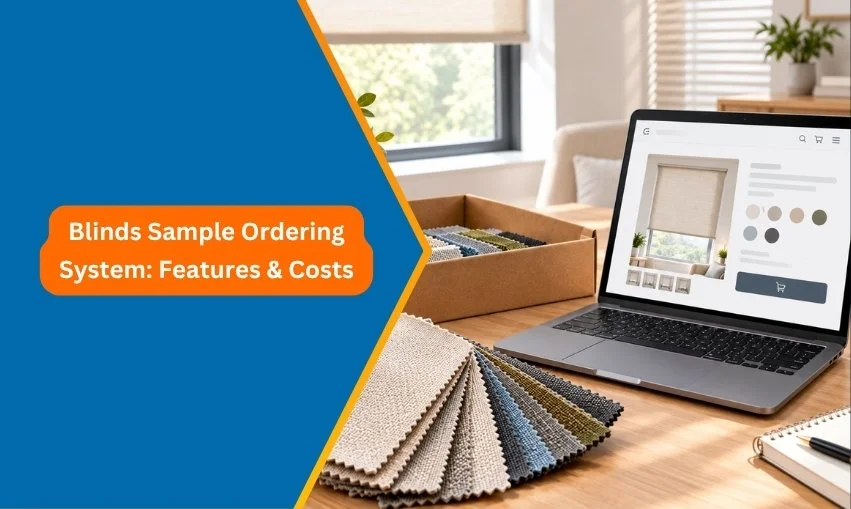
Blinds are a high-consideration purchase. Nobody’s dropping $300 on Roman shades they haven’t seen in person. That’s a real problem when you’re building e-commerce platforms for blinds retailers. Customers add samples to their cart, then abandon it. They’re just not confident enough to commit without touching the fabric first.
Here’s what most agencies miss: a free sample ordering system. It’s not complicated to build, but it’s one of the best things you can add to move that needle. Somehow it still gets deprioritized or skipped entirely on a ton of blinds sites.
In this guide, I’ll walk through why this feature actually matters, how to build it, and what to expect on Shopify, WooCommerce, and Magento.

See How Our Experts Can Drive More Traffic to Your Website!
SEO: Boost your rankings and drive more organic traffic today!
Website Design/Development: Create a stunning website that converts visitors into customers.
Paid Media: Reach the right audience at the right time with expertly managed paid media.
Why Sample Ordering Matters for Blinds Platforms
Before diving into the technical build, let’s establish why this feature is worth the development effort.
Reduces Purchase Friction
People don’t impulse-buy custom blinds. They need to see that the color actually works in their space, that the texture doesn’t clash with what they’ve got, and that the quality is worth what they’re paying. Without samples sitting in front of them, they just bail. A free sample ordering system kills that uncertainty in one move. Once someone’s holding the fabric, seeing it in their own lighting, and feeling the quality firsthand, the sale feels obvious.
Increases Average Order Value
When people have samples in hand, they upgrade. They’ll go for the premium fabric they were too nervous about. They’ll throw in motorization or paid add-ons because they already know exactly what they’re getting. It’s not just that more people order, it’s that the people who do order spend more.
Decreases Returns and Complaints
People who order without samples come back frustrated saying “this isn’t what I wanted.” Returns kill blinds retailers. There’s the shipping cost, the inspection, possibly paying to refurbish it. Samples cut that problem almost entirely. If someone already saw and touched the fabric, they’re not returning it.
Competitive Advantage
Most blinds platforms don’t have sample ordering built in. It’s a feature gap across the industry. Agencies who build it gain a selling point when pitching to blinds retailers, especially those already losing sales to platforms that offer samples.
Technical Approaches to Building Sample Ordering
You’ve got three main paths to build this, and they each have things going for them and things that suck about them.
Custom-Built Workflow
Build the whole thing yourself. Sample picker, inventory tracking, fulfillment emails, follow-up sequences. You get complete control over how it works and what it looks like, but you’re on the hook for building and maintaining all of it.
Best for: Teams with bandwidth and clients willing to pay for something custom.
Third-Party Plugin or SaaS
Grab an existing tool that already does this. Shopify apps, WooCommerce plugins, whatever. Faster to get live, way less to maintain. Downside: you’re stuck with what they built, your client pays recurring fees, and sometimes the data doesn’t sync right.
Best for: Quick timelines and clients who don’t care about customization as long as it works.
Platform-Native Integration
Build something that lives inside the platform itself, following their rules (Shopify app, WooCommerce plugin, Magento module). You get way more control than SaaS, but it’s faster to build than a custom system. Plus you can reuse it across clients.
Best for: Agencies that specialize in one platform and want to ship the same solution multiple times.
Core Components of a Sample Ordering System
No matter which path you pick, you need these pieces to actually work:
Sample Inventory Management
Keep track of what you have. Fabric swatches aren’t free. Blinds retailers have maybe 30-50 samples of each color, and they need to know when they’re running low. You don’t want customers requesting samples you’ve run out of.
Simple database table: SKU, quantity on hand, how many have been requested, reorder level. Flag anything low so the client knows to restock.
Request Workflow
This is what the customer sees. They pick fabrics, enter an address, hit submit. Don’t overcomplicate it or people bail.
Here’s the flow:
- Pick 1-5 samples (cap it so they don’t spend all day deciding)
- Enter or confirm shipping address
- Get a confirmation (page or email)
- Your team gets a pick list email
Fulfillment Integration
Once they submit, your team needs to know about it. Options:
- Email to your fulfillment inbox
- Integration with ShipStation, Shopify orders, whatever they already use
- API push to their inventory system
- Dashboard showing pending requests
Pick what fits their existing process. Most blinds retailers aren’t running some enterprise fulfillment setup. A lot of them still pack samples in their warehouse.
Follow-Up Automation
This is where you actually make money. Set up automated emails:
- Confirm it (right away)
- Shipping notification when it goes out (day 2-3)
- Nudge if they haven’t ordered (day 7-10)
- Maybe a discount if they order within 30 days
Samples alone don’t move the needle. The follow-up is what closes deals.
Analytics and Attribution
Track the numbers that matter:
- Sample request rate (what % of visitors ask for samples)
- Which colors and fabrics people actually want
- How many sample requesters become buyers
- How long between sample request and order
- Do sample requesters spend more long-term than others
Put this on a dashboard. Your client needs to see the ROI. That’s how you get them to fund the next feature.
Implementation Considerations by Platform
Shopify
Shopify’s app market has a bunch of options. You can build your own app or plug in an existing one. If you’re doing Shopify development for blinds shops, building this natively is a real differentiator.
Advantages:
- Shopify handles the infrastructure
- Works with their orders, inventory, and customer system
- Clients can use Shopify fulfillment apps
- Ships pretty fast
Challenges:
- Their app review is slow
- Can’t customize the checkout much
- If you sell it, Shopify takes a cut
- Inventory sync is polling, not real-time
Best practice: Build samples as a $0 order type in Shopify, then sync the data to your own system if you need to.
WooCommerce
Total control. Build a plugin using their API and hooks. For WooCommerce development on blinds sites, a custom sample system integrates right into the product and order setup.
Advantages:
- You can build it exactly how you want
- Deep inventory integration is easy
- One-time cost for the client (no recurring fees)
- Reuse it across clients
Challenges:
- Takes more time to build than Shopify
- You maintain it when WooCommerce updates
- Client handles hosting unless you do
- Less polish than Shopify
Best practice: Use custom post types for sample requests, separate from regular orders. Keeps things clean.
Magento
The heavy-duty option. Magento 2 or Hyväcommerce. For blinds shops with weird pricing rules and multiple stores, Magento development gives you the most flexibility.
Advantages:
- Handles complex pricing and inventory setups
- Deep control over checkout
- Build sample rules exactly how you want
- Good API docs
Challenges:
- Steeper learning curve
- Harder to maintain
- Needs experienced Magento devs
- Takes longer to build
Best practice: Build it as a proper module. Use Magento’s quote system for samples. Leverage their event system for automations like emails.
Measuring ROI of a Sample Ordering Feature
You need to prove this actually works. Blinds retailers won’t care about your feature if you can’t show them it moves the needle.
Key Metrics to Track
- Request rate: 100 visitors, 5 request samples. That’s 5%. Typical range is 2-10% depending on who’s visiting.
- Conversion rate: Of those 5 sample requesters, how many buy? 2 out of 5 is 40%. This goes up over time as your follow-up emails get better.
- Time to purchase: Days between sample request and actual order. Tells you if people take a week or three months to decide. Helps you figure out when to send emails.
- Lifetime value: Do sample requesters spend more over time than people who didn’t? Usually yes, because they’re more committed.
Attribution Strategy
Tag sample requesters. When they come back and buy, match them to their original request. That’s how you prove the connection.
Most blinds shops have no idea how much samples actually help because they don’t track it. Set this up from day one so after 90 days you’ve got real numbers to show.
Conclusion
A free sample ordering system is probably the single best ROI feature you can add to a blinds platform. Real problem, easy to build, measurable results.
The build isn’t hard. What matters is the details. Clean request flow, fulfillment that actually works, and follow-up emails that push people to order.
If you’re building blinds shops, this belongs on your roadmap. For the bigger picture on blinds eCommerce, read the full blinds e-commerce development guide. And if you’re looking to build or redesign a blinds platform from scratch, check out our blinds website design and development services.
Pick your platform based on what your client needs and what your team can maintain. Shopify is fast. WooCommerce is flexible. Magento is powerful.
We build this all the time on all three platforms. If you want to add sample ordering to your blinds store or want to talk through the technical approach, let’s chat. Reach out to discuss your blinds e-commerce project.
Frequently Asked Questions
How much does it cost to build a free sample ordering system?
Depends on platform and how custom you go. Shopify app is roughly $3K-8K. WooCommerce plugin is $5K-15K. Magento is $10K-25K+. Add support and maintenance on top. Usually pays for itself in 3-6 months if they’ve got traffic.
How do we handle sample fulfillment logistics?
Whatever they’re already doing. If they pack samples by hand, send them an email with a pick list. If they use ShipStation or some other partner, hook into their API. Don’t overcomplicate it or the whole thing dies.
What's the typical conversion lift from adding samples?
People who request samples convert at 30-50%, versus 5-15% for everyone else. Total lift depends on how many people actually ask for samples. If 5% of visitors request and 40% of those buy, that’s a 2% overall lift. On a $100K/month store, that’s $2K-5K extra per month.
Should samples be free or paid?
Free. Charge anything and people stop requesting. The sample cost is nothing compared to a $300 order, and your goal is to get fabric in their hands so they buy. That’s it.
Can we integrate this with third-party fulfillment services?
Yeah. ShipStation, Shippo, whatever. Push sample requests to their system. If they’ve got something custom, check if they have an API. Email is the fallback if nothing else works.

About the author
Nitin D
Digital Marketing Manager
Nitin is the Digital Marketing Manager at Icecube Digital. He has helped many organizations grow their business online and improve sales through effective SEO, PPC and content marketing strategies built around measurable results.