
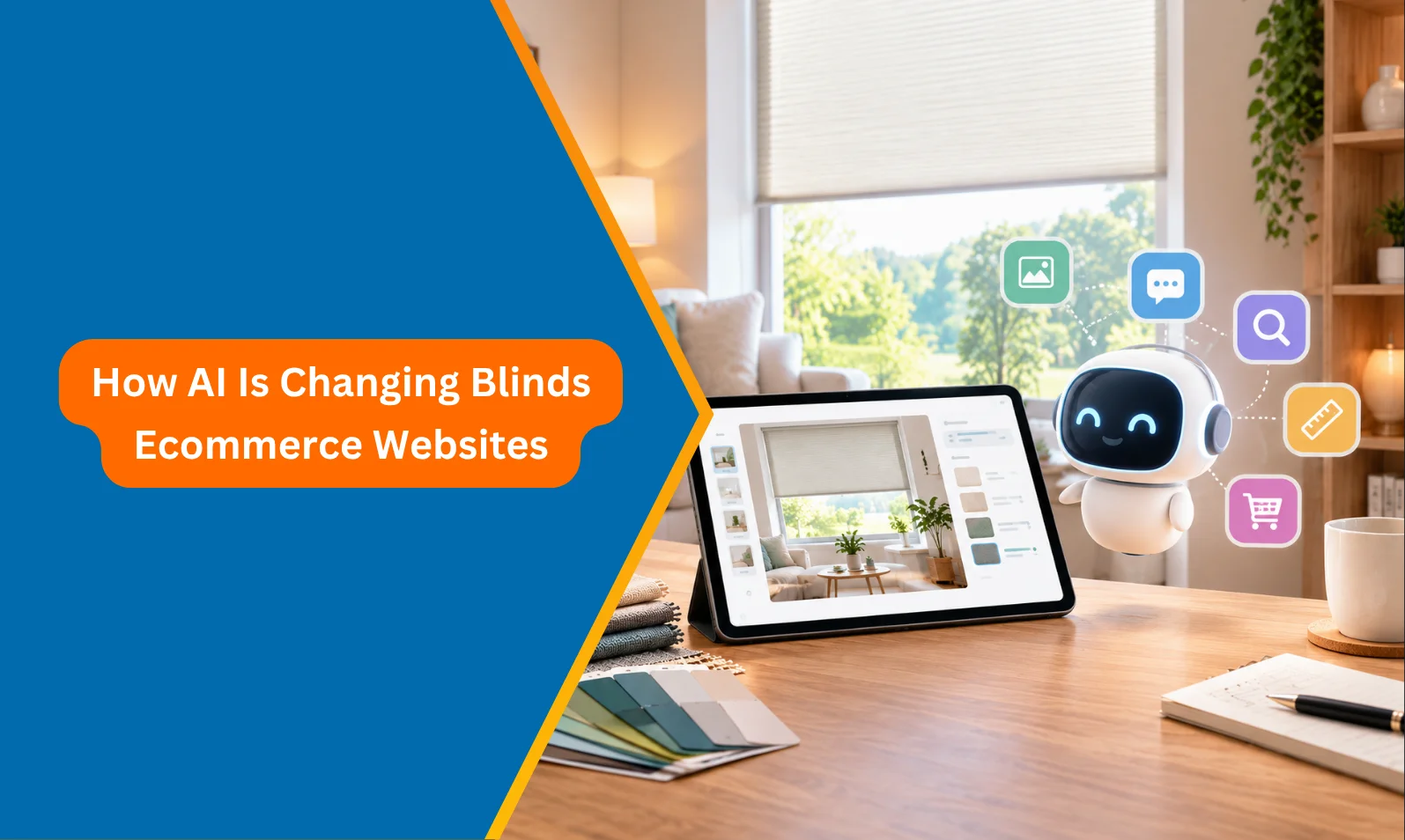
Not long ago, AI in blinds ecommerce meant a chat bubble in the corner that could tell you the store’s opening hours, and not much else. That’s changed. Stores now let shoppers try a fabric on a photo of their own window, get help measuring a bay window at 9 pm, and type “blackout blinds for a nursery” into search without getting zero results.
So where is AI in ecommerce actually paying off for blinds and curtains businesses? That’s what this post looks at, along with how each feature works on a real store and where it still trips up. If you run or manage a store and you’re weighing up what to add next, it’s for you. No technical background needed.

See How Our Experts Can Drive More Traffic to Your Website!
SEO: Boost your rankings and drive more organic traffic today!
Website Design/Development: Create a stunning website that converts visitors into customers.
Paid Media: Reach the right audience at the right time with expertly managed paid media.
What AI Does on a Blinds Ecommerce Website Today
Most AI in blinds ecommerce falls into a few areas. Visualizers and room previews put the product into the shopper’s own room. Chatbots pick up the measuring, product, and “where’s my order?” questions your team already fields every day. Smart search and recommendations help people land on the right fabric even when they’ve never heard your product names. And on the marketing side, more stores are paying attention to how AI assistants and Google’s AI Overviews describe them.
An AI ecommerce website doesn’t need all of this at once. In our experience, the best place to start is wherever shoppers get stuck. On blinds stores, that is usually one of two moments: picking a fabric or working out the size.
Window Treatment Visualizers and Room Previews
Before anyone orders a made-to-measure blind, they want to know how it will look in their room. A window treatment visualizer is built to answer exactly that.
Blinds Visualizer for Real Window Photos
With a blinds visualizer, the shopper snaps a photo of their window or uploads one they took earlier. The AI picks out the window frame and lays the chosen blind over it. They can then flick through fabrics, colors and blind types on that same photo, which is a lot quicker than ordering six samples.
The real test comes after the preview. Say a shopper likes a grey linen roller on their kitchen window. Can they tap once and land in the configurator with grey linen already picked? If the preview and the product page aren’t connected, most people play with it for a minute and leave.
Curtain Visualizer for Fabric, Fullness and Length
Curtains are trickier to show than blinds. Fabric hangs, it folds, it gathers at the heading, and color alone tells a shopper very little. A curtain visualizer has to let them hold a sill-length pair up against a floor-length one, swap pinch pleat for eyelet, and see roughly how full the curtains look once they’re drawn.
Those two things, length and fullness, are what curtain buyers email about most before they’ll commit. A preview that shows both saves a lot of that back-and-forth.
Room Size Preview Mode
Plenty of room visualizer and virtual room planner tools exist, but they’re mostly for styling. Think paint, sofas and rugs. Blinds buyers have an extra question, which is how the product looks at their real size. Icecube Digital has built a preview mode for this. It shows the product at the size of the shopper’s own room or window, using the measurements they enter.
The benefit is simple. People notice proportion problems before they pay, for example a blind that will look narrow on a wide frame. Because the preview uses the same measurements as the price, it fits neatly alongside blinds product configurator development.
AI Chatbots for Blinds and Curtains Stores
An AI chatbot for ecommerce is worth having on a blinds store if it can take the repeat questions off your team’s plate.
Measuring, Mounting and Product Questions
On most blinds stores, the same questions come up every week. How do I measure for an inside mount? What’s the difference between blackout and light filtering? Which blinds are fine in a bathroom? Are there cordless options for a child’s room? How long do samples take? Where is my order?
A chatbot can handle all of these, provided it answers from the right material. Our chatbots only answer from what the store has published itself: its measuring guides, its product data, its policies. Nothing from the wider web. Which tool you use matters much less than that. Left to general web knowledge, a bot will happily tell a customer to measure the way some other company recommends. A chatbot tied to your guides gives your answers, in your terms. With the store’s own data behind it, the chatbot can also point people to a product, so it ends up working as an AI shopping assistant too.
Handover to Your Sales Team
Then there’s the handover. A chatbot should know which conversations aren’t its job. Quote requests for commercial work go to your team. So do complaints about remakes or parcels that arrived damaged. If a customer has an odd-shaped window and sounds unsure of their size, that one gets passed on too.
The whole chat should travel with the handover, because nobody wants to explain a problem twice. We also stop the chatbot from approving final measurements. Get it wrong by 20 mm on a 1,400 mm blind and you’re making it again at your own cost. That’s why the sign-off belongs with the customer or your team.
AI Search and Smarter Product Recommendations for Blinds Stores
AI search for ecommerce isn’t the same as the search box most stores still run. The old box matches words. AI search tries to work out what the person is after.
Search by Room, Light and Use
Most shoppers have never seen your product names before they arrive. In the search bar they write things like “blinds for a south-facing bedroom,” “something waterproof for the shower window” or “drapes that block light.” Plenty of store search tools return nothing at all for those.
The smart AI search Icecube Digital has built for client stores reads the meaning behind the query. Type “shades” and blinds appear as well. Type “waterproof” and you’ll see moisture-resistant fabrics. “Block light” goes straight to blackout and room-darkening ranges. Typos don’t lead to an empty page either.
There’s a bonus, too. Once your product data is tidy enough for AI search, Google finds it easier to read as well. That’s why we often do this work alongside SEO for window blinds and shutter companies.
Personalized Product Recommendations by Window Type
AI product recommendations are most helpful when they follow how blinds are actually bought. “Customers also bought” is a weak signal on a blinds store. What the window is, which room it’s in and what the shopper has already looked at are much stronger ones.
That’s what good personalized product recommendations look like in practice. A shopper who ordered three grey samples last week sees similar greys first. Someone who picks a roller that can be motorized gets offered the motor, hub and remote right there. Configure a bedroom blind, and a matching valance or a pair of curtains for that room could appear next. Ten minutes browsing bathroom blinds should mean moisture-resistant fabrics start showing up. People click on suggestions like these because they follow what they were already doing.
Getting a Blinds Store Cited in AI Overviews and AI Answers
Ask an AI assistant “what blinds work in a north-facing room?” and it will usually name a few stores or brands in its answer. Those names come from websites it could read without much effort, and that it had some reason to believe.
There isn’t a guaranteed method for how to rank in AI overviews, and anyone selling one deserves some caution. What we see on the blinds sites that do get mentioned is fairly unglamorous. On their product pages, the basics are spelled out. This fabric is a linen blend. It blocks most light, but not all of it. It’s fine for a bedroom and not for a steamy bathroom. Their guides get to the point fast. If the question is how to measure a bay window, the first sentence is about measuring a bay window. We also tend to find their contact details are identical wherever you look them up, whether that’s the site itself, the Google Business Profile or an old directory listing. Even the suite number matches. Product and FAQ schema sits on top, labeling all of it for search engines and AI tools.
In a lot of businesses, nobody owns this. It tends to fall through the gap between whoever handles SEO and whoever writes the content. When you want a single team looking after it, AI SEO services for blinds and curtains brands cover how your store shows up in Google, AI Overviews and AI assistants.
Adding AI Features to an Existing Blinds Store
A new store usually isn’t required. Chat, search and visualizers can be fitted onto most existing blinds stores, provided the product data behind them holds up. Gaps in the data turn into gaps in what the AI can tell people.
Your inbox is a good place to begin. Go back over the last month of contact form messages and jot down the questions you keep seeing. Your analytics will show which pages people leave from. The busiest of those is usually the right place to try AI first. Then open a few product pages, any five or six, and look at which fields are actually filled in. Blank opacity or material fields mean a chatbot has nothing to work with on those products.
You’ll also have to decide whether to buy a tool or have one built. Apps and plugins win on speed. A custom build is slower to deliver, though it’s made around your made-to-measure pricing and your configurator, and it can use your own guides. On products with dozens of options, that’s usually worth the wait. Before either goes live, agree on what you’re going to measure. Resolved chats, searches that return nothing, visualizer use and sample orders are all easy to track before and after launch.
Occasionally the honest answer is that AI won’t help yet. A slow store, or a configurator that keeps its data to itself, needs fixing before anything gets added on top. Fix the store first, which is the kind of job covered by blinds and curtains website design and development.
Where AI Still Falls Short in Blinds Ecommerce
Made-to-measure products are good at finding the gaps in AI. Better you hear about them here than from a customer.
Measuring is the big one. AI looking at a photo has no way of knowing whether a recess is 914 mm or 921 mm. Seven millimeters is enough to stop a blind fitting. Visualizers are about appearance. It can’t tell you it’ll fit. Someone still has to get the tape measure out, either the customer or your fitter.
Color causes its own trouble. A fabric that looks soft cream on one phone can look closer to beige on another. Take the photo under evening lamps and it changes again. A visualizer gets shoppers close. When a customer is torn between two similar shades, send them the samples.
Chatbots have a habit of being wrong in a very sure voice. If something isn’t in its data, it may guess and present the guess as fact. Keep it on your own content. Every few weeks, have someone on the team skim a batch of its chats.
Underneath all of it is product data. Leave opacity, room suitability or material blank and search results start to wander. The recommendations get odd, too, and shoppers spot that faster than you’d think. That’s why clear, accurate product descriptions for blinds and curtains come first, before any of these features.
Conclusion
Not every AI feature is worth the money. The ones that are fix something shoppers already struggle with. They can’t picture the blind in their room. They worry about measuring wrong. They don’t know what you call the fabric they want. Visualizers, chatbots and smart search already handle those jobs well, as long as they’re built on clean product data and a store set up for made-to-measure. Measuring and color will need a human check for a while yet. That’s where AI in blinds ecommerce stands today.
Icecube Digital builds AI features for ecommerce stores, including chatbots, smart AI search and room size preview modes, along with configurators and the stores themselves. Contact Icecube Digital to talk through which AI features would help your blinds store most.
Frequently Asked Questions
Do AI room previews reduce returns and remakes for made-to-measure blinds?
They tend to cut down the “it’s not what I expected” complaints, since the customer has already seen the product against their own window. They do nothing for sizing errors, though. Those still come down to clear measuring guides, and samples help with color.
Does a small blinds store really need a chatbot?
Not always. Start by counting how often the same questions arrive. A store answering the same measuring and delivery questions daily will get real value from a chatbot trained on its guides, especially outside office hours. A store with a few complex inquiries a week is often better served by a contact form and a fast reply from someone who knows the products.
Should a blinds chatbot quote prices?
Only when the price comes directly from your configurator or price grid. Otherwise, sooner or later, a shopper gets told $189 and then sees $214 at checkout. Guess who ends up answering that email.
Do we need to tell shoppers what happens to their window photos?
Yes. Before picking a visualizer, get the vendor to put it in writing: where uploads are kept, for how long, and whether anything is trained on them. Then add a sentence about it next to the upload button, plus a link to your privacy policy.
Is AI good enough to write our fabric descriptions?
Yes, as a starting point. AI will turn out drafts quickly. It won’t notice if a fabric is listed as blackout when it’s really room darkening, though. Left alone, it will also write 200 pages that sound much the same. That checking is a job for someone on your team, using the supplier specs.
How much time does adding AI search or a visualizer take?
An off-the-shelf app is quicker, sometimes much quicker. Custom work connects to your configurator, price grids and product data, so it needs planning and proper testing before it goes live. What usually slows things down most, though, is product data that has to be tidied first.
Will people actually take measuring advice from a bot?
Most will, if the advice matches what your measuring guide says and a real person is one click away. Trust drops fast when the bot hedges or contradicts the website. Keeping it tied to your published guides avoids that most of the time.

About the author
Nitin D
Digital Marketing Manager
Nitin is the Digital Marketing Manager at Icecube Digital. He has helped many organizations grow their business online and improve sales through effective SEO, PPC and content marketing strategies built around measurable results.