
Many people who are shopping for blinds or curtains do not know the correct name for what they want. They may have seen a particular fabric in a friend’s living room, admired a room photo online or noticed a style in a hotel, and they find it much easier to show that image to a search engine than to describe it in words. Visual search for blinds makes this possible, and it is becoming a more common starting point for buyers of window treatments.
In this article, we look at how visual search works for blinds and curtains, why window treatment images are more difficult to match than many other products, and what a store can do in terms of photography, image SEO, Google Lens, Pinterest and measurement. The aim of visual search SEO is not only to rank in image results, but to make sure that a shopper who searches with a photo arrives at the right product.

See How Our Experts Can Drive More Traffic to Your Website!
SEO: Boost your rankings and drive more organic traffic today!
Website Design/Development: Create a stunning website that converts visitors into customers.
Paid Media: Reach the right audience at the right time with expertly managed paid media.
Why Visual Search SEO Matters for Blinds and Curtains
With regard to window treatments, the appearance of the product is the deciding factor for the majority of buyers. Color, texture and pattern, along with the way the fabric looks after it has been hung in a room, are the things customers pay attention to, and every one of these is simpler to recognize in a picture than it is to type into a search box.
What Happens When Someone Photographs a Blind With Google Lens
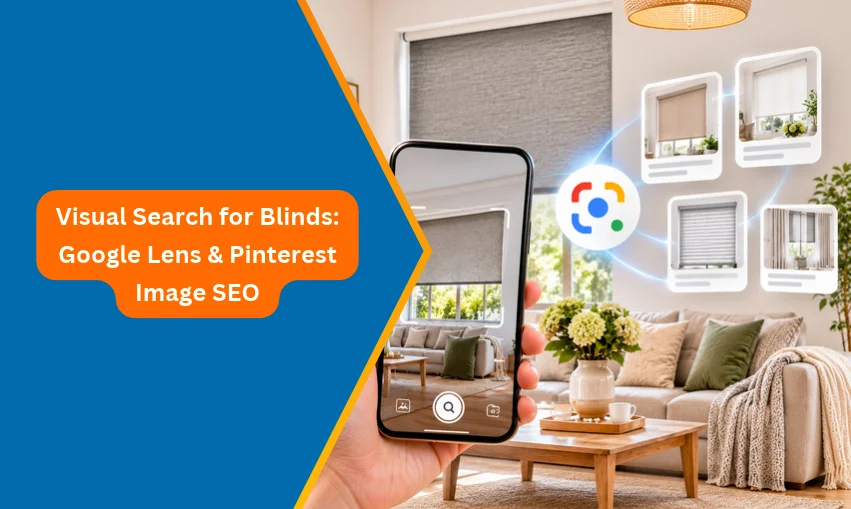
A shopper can aim Google Lens at a blind, a pair of curtains or even a photo of a whole room. The tool then looks at the picture and brings back products that resemble it, each with a link to a page where it can be purchased. Circle to Search, which is available on many phones, works in much the same manner, by letting the user select an item inside a social media post or a web page. Since Google has been promoting both tools to people shopping for home decor, it is reasonable to expect that this way of searching will be used more often over time.
What this means for a blinds retailer is that its product images have become an entry point into search in their own right. Where the images are clear, properly labeled and linked to well-structured product pages, there is a fair possibility of the store showing up in the results. Where they are not, the shopper will most likely be sent to another store.
Why Similar Fabrics Confuse Visual Search
Products with a distinctive outline, such as a pair of trainers or an armchair, are usually matched by visual search without much difficulty. Window treatments are a different matter. One roller blind made in pale grey linen can look almost identical to a large number of other roller blinds in similar grey fabrics, and what separates them is mostly the texture, the weave or the amount of light the fabric blocks, not the shape of the blind.
The lighting in a photo causes a further problem. A fabric that reads as a cool grey in daylight may look closer to beige in a room photographed under warm lamps in the evening, and a visual search tool can then connect it with the wrong product altogether. For these reasons, careful photography and correct image information carry more weight for blinds and curtains than they do in many other product categories.
Blinds Product Photography for Visual Search
Good window treatment images form the basis of everything else in this article. Search engines can only work with what they are shown, so the quality and consistency of product photography have a direct effect on how well a store performs in visual search.
Showing Fabric Color Accurately in Every Light
Accurate color begins with consistent lighting. Product photos should ideally be taken in controlled conditions, using neutral, daylight-balanced light, and with the camera’s white balance set correctly or checked against a grey reference card. Editing should correct obvious color casts without making fabrics look brighter or more saturated than they really are.
Where a fabric looks noticeably different in daylight and in artificial light, it can be helpful to show both, and to say so in the product description. This sets realistic expectations for customers and also gives visual search tools a more complete picture of the product.
The Image Set Every Blinds Product Page Needs
A single photo is rarely enough. A strong blinds product page usually includes a clean product shot on a plain background, a close-up of the fabric that shows its texture and weave, a mounted shot of the blind fitted in a real window, and at least one room photo that shows the product in context. Where relevant, detail shots of the controls, headrail or brackets are also useful.
Each type of image serves a different purpose. The plain product shot helps search engines identify the item itself, the close-up helps with fabric matching, and the room photo reflects the kind of image a shopper might use as the starting point for a visual search.
Consistent Angles Across a Fabric Range
When a store offers the same blind in many fabrics, the photos for each fabric should be taken from the same angles, at the same distance and with the same lighting. This consistency makes the range look more professional, and it also helps search engines understand that the images represent variations of a single product rather than unrelated items.
Consistency is easier to maintain when it is planned as part of the store’s design and product structure from the beginning. This is one of the areas we consider when working on blinds and curtains website design and development, since the way images are organized on the site affects both shoppers and search engines.
Image SEO for Blinds Product Pages
Photography on its own is not enough. Search engines also rely on the text and data that surround each image to understand what it shows and which page it belongs to. Image SEO covers this supporting information, and it is an area that many blinds stores overlook.
Naming Image Files for Hundreds of Fabric Variants
File names should describe what the image shows, rather than being left as the default names produced by a camera or a design tool. A name such as “grey-linen-blackout-roller-blind-living-room.jpg” gives search engines far more useful information than “IMG_4521.jpg.” For image file names SEO, words should be separated by hyphens and kept reasonably short.
For stores with hundreds of fabrics, file names can be generated automatically using a consistent pattern that includes the product type, fabric name, color and image type. This approach keeps names accurate across the whole range and avoids the time involved in renaming files manually.
Writing Alt Text for Blinds and Curtains Images
Alt text is a short written description of an image. It is read aloud by screen readers for visually impaired users, and it also helps search engines understand the content of the image. Good alt text for product images describes what is visible in plain terms, for example “Grey linen blackout roller blind fitted in a white kitchen window.”
Effective image alt text for SEO should be accurate and specific, and it should not be filled with repeated keywords. Each image should have its own description, so a close-up of the fabric and a room photo of the same blind should be described differently. Alt text works alongside the main product description, and both benefit from the same attention to detail. The approach to writing clear product descriptions for blinds and curtains applies equally to image descriptions.
Adding Image Sitemaps and Product Schema to a Blinds Store
An image sitemap lists the images on a website and the pages on which they appear, which helps search engines find images that might otherwise be missed, particularly those loaded by scripts or within configurators. Product images can be included in an existing sitemap or listed in a separate one, and the sitemap should then be submitted through Google Search Console.
Product structured data, often referred to as schema, provides search engines with organized information about each product, including its name, price, availability and images. Including several images in the schema, covering different angles and views, gives search engines more to work with. It is also advisable to keep image URLs stable once they have been indexed, since changing them frequently means search engines have to discover and process the images again.
This technical work is an important part of a wider strategy, and it is covered as part of our SEO for window blinds and shutter companies.
How Google Lens Shopping Matches Photos to Blinds Products
Google Lens shopping results draw heavily on product information supplied to Google, including the images and data submitted through Google Merchant Center. For stores that sell online, this feed is one of the most direct ways to appear when a shopper searches with a photo. It is also the part of Google Lens SEO that a store has the most direct control over.
Choosing Merchant Center Images for Custom-Size Blinds
Google Merchant Center images should show the product clearly and accurately. Google’s guidelines ask that the main image represent the product being sold and avoid promotional text, watermarks and borders, and they favor high-resolution images. For blinds, a clean product shot or a well-lit mounted shot usually works best as the main image, with room photos and close-ups added as additional images.
Made-to-measure products bring an extra consideration, because each blind is produced in the customer’s chosen size. In practice, most stores submit one product per fabric or style, using a standard starting size and a representative image, rather than attempting to submit every possible size. The image should match the fabric and style named in the product title, so that the visual and written information point to the same item.
Landing Visual Search Visitors on the Right Product Page
Appearing in visual search results is only valuable if the shopper arrives at the correct product. If someone searches with a photo of a sage green Roman blind, the link should take them to that fabric and style, not to a general category page where they have to start their search again.
On stores with a configurator, it is also helpful if the link opens the product with the matching fabric already selected. This reduces the number of steps between the search and the order, and it is something we plan for when working on blinds product configurator development.
Pinterest SEO for Blinds and Curtains Stores
Pinterest is a visual discovery platform where many people collect ideas for decorating their homes, and window treatments are a natural fit for it. Pinterest SEO involves making pins, boards and product information easy for both Pinterest’s search and its visual search tools to find.
Setting Up Pinterest Rich Pins for Blinds Products
Pinterest rich pins automatically pull information from the product page on the store’s website, such as the product title, description and, for product pins, the price and availability. To use them, the store generally needs to claim its website in a Pinterest business account and make sure its product pages include the relevant metadata.
Pinterest product pins go a step further by connecting a full Pinterest catalog to the store, usually through a product data feed. This allows products to appear in shopping features on the platform and keeps prices and availability up to date without the need to update each pin by hand.
Pinterest for Ecommerce: Room-Based Boards for Blinds and Curtains
People on Pinterest usually search by room or by style rather than by product name, using terms such as “bedroom window ideas” or “neutral living room curtains.” For Pinterest for ecommerce, it is therefore effective to organize boards around rooms and styles, such as kitchen blinds, nursery blackout options or Scandinavian living rooms, rather than around product types alone.
Pin titles and descriptions should use natural language that matches these searches, and every pin should link back to the relevant product or category page on the store. Room photos tend to perform particularly well on the platform, which is another reason for investing in good lifestyle photography.
How to Track Traffic From Google Lens and Pinterest
Measuring the results of visual search optimization is not always straightforward, but there are several useful sources of data.
In Google Search Console, the performance report can be filtered by search type to show image results separately, which reveals how often product images appear and how many clicks they receive. Traffic from Google Lens is not always reported as a separate source in analytics tools, so it is sensible to watch image search performance alongside overall organic traffic to product pages. On Pinterest, the business account’s analytics show impressions, saves and outbound clicks for each pin and board.
Visual search also overlaps with the way AI tools and AI assistants find and describe products. For stores that want to cover this area alongside traditional search, AI SEO services for blinds and curtains brands look at how a business appears across Google, AI Overviews and AI assistants.
Conclusion
Visual search for blinds is likely to become an increasingly common way for customers to find window treatments, because it matches the way people naturally choose them: by appearance. Taking advantage of it does not require anything unusual. What it does require is photography that is consistent and true to color, file names and alt text that describe each image, product data marked up in a structured way, an image sitemap, and feeds for Google Merchant Center and Pinterest that have been prepared properly. Shoppers who reach the store through ordinary search will also find the site easier to use as a result of this work.
At Icecube Digital, we build blinds and curtains stores and look after their optimization, which covers the way product images are organized, the structured data behind them and the wider SEO that brings products to the attention of buyers. Contact Icecube Digital to discuss how your product images could be performing better across Google Lens, Pinterest and regular search results.
Frequently Asked Questions
Does Google Lens work on room photos, or only on product shots?
Room photos can be used as well. Lens is capable of picking out a single item, a blind or a curtain for example, from a picture of a full room, and it will then look for products that are similar to it. That said, a plain product shot is easier for the tool to match, so it makes sense for a store to have images of both kinds.
Should every fabric color have its own product image?
Ideally, yes. A fabric that has never been shown on the site cannot be matched by a visual search tool, so if a customer searches using a photo of one particular shade, the chances of finding it are much higher when that same shade has a clear image of its own.
Is AI-generated room imagery suitable for blinds product pages?
Caution is advised here. Images of rooms produced by AI can help to suggest a style or a look, although they do not always show the true color and texture of a fabric. For the images that represent the actual product, and in particular the main image sent to Google Merchant Center, real photographs are still the safer choice.
How many images should a blinds product page include?
No exact number applies to every product. A well-presented page will usually have a product shot on a plain background, a close-up of the fabric, a shot of the blind mounted in a window, and one or more photos of it in a room. For motorized blinds especially, extra pictures of the controls or brackets tend to be appreciated by customers.
Do watermarks affect visual search results?
In many cases they do. When a watermark or a line of promotional text is placed over a picture, visual search tools find it harder to recognize what the product is, and Google’s guidelines for Merchant Center ask for the main product image to be free of them. A small logo on a lifestyle photo posted to social media is generally less of an issue.
How long does it take for new product images to appear in visual search?
The timing is not fixed. New images have to be found and processed by search engines first, which might happen within a few days or might take a number of weeks. Sending an updated image sitemap and keeping the Merchant Center feed up to date normally helps the new images to be picked up more quickly.
Is Pinterest worth the effort for a small blinds business?
For a lot of smaller businesses, the answer is yes. The platform is centered on ideas for the home, and a pin can carry on sending visitors to a store for a long time after it was first published. The main costs involved are good photos of rooms and the time needed to link each pin to the correct product page, and the store’s own website benefits from both of these as well.

About the author
Nitin D
Digital Marketing Manager
Nitin is the Digital Marketing Manager at Icecube Digital. He has helped many organizations grow their business online and improve sales through effective SEO, PPC and content marketing strategies built around measurable results.