


A few years back, search engine optimization was all about ranking in the top spots on Google’s first page. Cut to now, the motive of SEO is changing, rather, evolving.
Instead of asking Google about “top best shoes for running”, users ask the same question to ChatGPT. If you may ask why, then the latter is more convenient to users.
These AI search engines offer instant, summarized answers without forcing users to browse through multiple links. If the user makes the prompt more specific, like “best running shoes for flat feet under $100”, it doesn’t just provide links. It instantly filters options, explains why each pick is suitable, and even highlights pros and cons in plain language.
So, for brands, this is high time to optimize their eCommerce store for AI SEO, such that the AI search engines will include their products in the results as well. Because the answers provided by the AI tools are more like recommendations.
How is AI SEO Actually Different from Normal SEO?
For brands that are just getting started with AI SEO, you might be wondering how AI SEO is different from normal SEO. The core objective remains the same, which helps users to find your brand, but the AI SEO changes the method of discovery.
Traditional search relies on keyword-based algorithms and indexing. Aligning the content as per the search queries helped in information retrieval. AI search works a bit differently. It understands the intent behind the search and context of a query and furnishes more personalized results.
However, the user will still visit your website to get more information about the product, browse the collection on your website to finalize, and make the purchase.
The eCommerce AI SEO strategy is all about:
- Making your product data readable for crawlers to understand
- Building credibility signals so that Google can trust the product/brand
- Adding unique content or expert information instead of generic descriptions, so AI considers your store a reliable answer source.
If you look closely, you’ve already been addressing many of these elements in your traditional SEO efforts. As Google’s Sullivan puts it, “Good SEO is Good GEO”.
He emphasized that generative engine optimization (GEO) or AI SEO follows the same core principles: creating unique, valuable content for people and providing a great page experience.
Let’s understand how to do AI SEO for eCommerce sites.

See How Our Experts Can Drive More Traffic to Your Website!
SEO: Boost your rankings and drive more organic traffic today!
Website Design/Development: Create a stunning website that converts visitors into customers.
Paid Media: Reach the right audience at the right time with expertly managed paid media.
Setting a Solid Foundation: How to Become Visible to AI Tools?
There are no confirmed, tried and tested tactics or AI solutions for eCommerce with sure-shot outcomes. Also, tactics don’t have a role in AI search because all AI does is deep dive and collates the information on the Internet for the users.
So, as SEO experts, all you need is Good SEO. Here are some key things that you can check to ascertain that your SEO foundations are solid, which form the basis for AI visibility:
1. Customer-centric
AI SEO is the natural evolution of traditional SEO. So, ensure that your strategy is customer-centric. Understand your audience, their needs, and pain points that the current market doesn’t bridge. Create personas, gather feedback, and map their buying journey. The better you mirror real customer intent in your content, the more accurately AI models will associate your brand with relevant queries.
2. Human, expert content
AI search engines just collate the information on the Internet. So if your content is generic (like it is on the same lines as what other brands have published), AI will treat it as just another reference point. To stand out, your content needs to reflect expertise. It needs fresh insights from interviews, research papers, and proprietary data, which is what humans are best at.
3. Strong branding
Strong branding is now essential as AI mentions increasingly drive users directly to homepages. Keep your brand name consistent across your site, socials, and product listings, and reinforce your key selling points everywhere. Create unique names for your products that are easy to search. Pair unique brand terms with words people actually type or say in AI prompts or search queries.
For example, for running shoes, you can write “AeroMax Pro 2.0 – Lightweight Running Shoes for Flat Feet” instead of “AeroMax Pro 2.0”.
4. Conversational content
Content is the king, whether we are referring to SEO or AI SEO. Your content should connect with the user. It should be interesting to read, answer the query in detail, and include follow-up questions. You should structure your content to cover all the questions that a user could have in their mind related to a query.
5. Diversified content
Except for Google and AI search engines, there are many different channels through which your target audience can discover you. Think Instagram, TikTok, YouTube, and Reddit. So, you should have a solid and active presence on every platform your audience spends time on, not just to drive traffic directly, but to reinforce your brand signals across the web.
Technical Modifications: How to Structure the Website for AI Crawlers?
Just like how site architecture and technical elements mattered in SEO, they are important for AI SEO as well. There are four important technical pillars that play an important role in AI SEO services:
1. Schema markup
Schema markup is important to make the crawlers understand your content. Schema markup is a structured data format (specified by Schema.org in JSON-LD format), which helps AI search engines to understand what your product is, how much it costs, and whether it is in stock or not.
Solution: Start by adding Schema markup to product pages first. You need to follow Product Schema, and it includes the following fields:
- Product name
- Product description
- Image
- Price
- Availability
- Brand name
- Ratings and Reviews
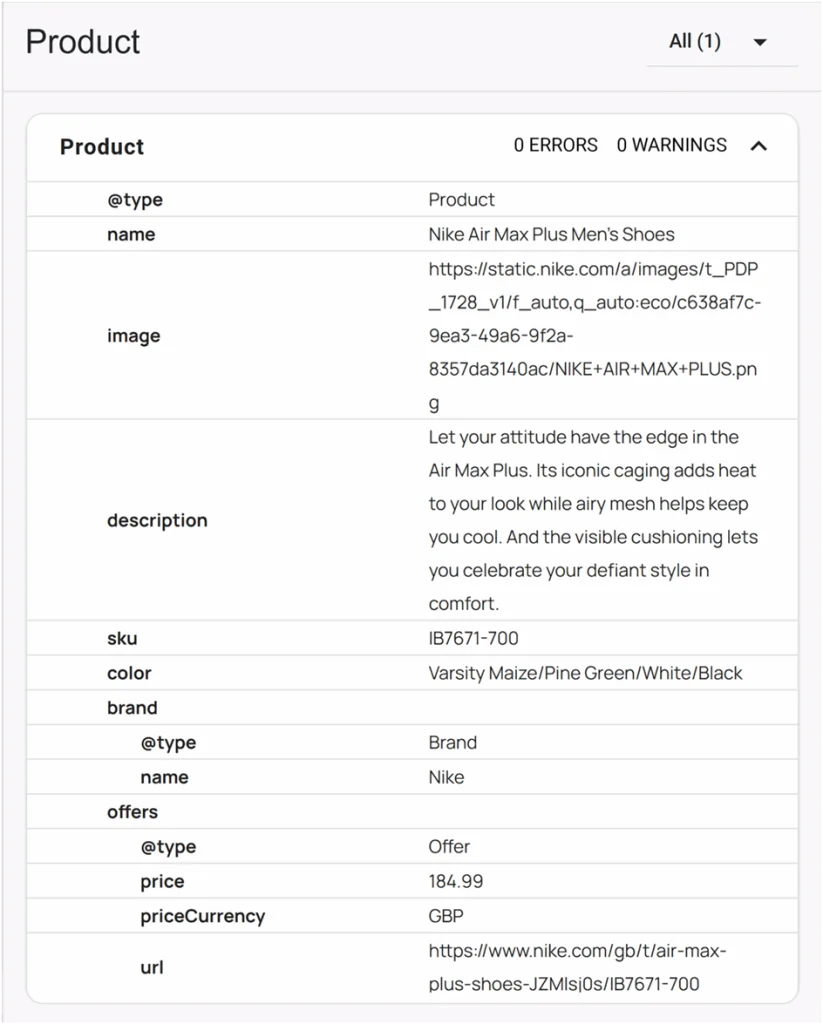
After adding product schema, you can work on adding review and aggregaterating blocks, FAQPage markup for PDPs and Help Center, and HowTo schema for tutorials.
2. Technical infrastructure
eCommerce websites are structurally complex. The online stores frequently deal with dynamic content, faceted navigation, product filters, session-based URLs, JavaScript-loaded elements, duplicate pages, and inconsistent product naming or metadata. All of these make it harder for LLMs to parse and interpret them accurately.
Solution: Here are some steps that will make your website technically sound and easy to understand:
- Unblock the AI crawlers in your robots.txt files (if you had them blocked); otherwise, they won’t be able to access and serve your pages in AI-generated results.
- Don’t serve the important contents, like product descriptions, pricing, images, and schema markup in JavaScript. Some LLMs cannot process JavaScript, so it will get missed.
- Check whether your pages are accessible to Googlebot and Bingbot, as many LLMs rely on those indexes.
- Ensure that you are using accurate publication/modifications dates, update notes are visible, and XML sitemaps have .
- Use security headers, like CSP, X-Content-Type-Options, and X-Frame-Options, along with HTTPS and valid SSL to establish trust.
Technical modifications might seem a bit overwhelming, but you can hire AI local SEO experts who can understand eCommerce complexities inside out and solve them.
3. Content structure
The AI crawlers don’t work like search engine crawlers. While Google’s crawlers scan URLs and index pages based on metadata, internal links, and keyword signals, AI models analyze content at a semantic and contextual level. They don’t just look for headings, but they go for clarity, hierarchy, and meaning.
Solution: So, you need to ensure that the content is easier for machine bots to parse and organize your content. Here are some important elements that you should consider including in your content structure:
| Logical URLs | Short and descriptive paths, like services/website-optimization, for clarity |
| Internal Linking | Go for bidirectional linking, like pillar pages to sub-pillar pages and vice versa |
| Header Tags | Use H1 – H6s header tags to create hierarchy and establish a flow |
| Structure Elements | Instead of long paragraphs, go for ordered steps, tables, and lists which are easier for LLMs to parse. |
4. Site speed and performance
Speed has been a ranking factor in Google since 2010, and now in AI SEO, it is a qualifying factor. The generative engines fetch information from billions of pages. So, if your website is slow, unstable, or inaccessible, then your website may get skipped.
Solution: Faster pages have better chances of getting included in AI-generated results, and they even convert better once the user clicks through and explores it to make the purchase.
For better performance and site speed, the AI SEO service experts can help. By performing a website audit, they can identify elements that slow down page loading. The team can even evaluate your Core Web Vitals, mobile responsiveness, and crawlability to ensure that both search engines and AI models can access and interpret your content quickly and accurately.
Focus on Content: Publish that AI Crawlers Can Understand
Your content strategy also needs to evolve. While working on AI SEO for product pages, you need to shift your focus from keywords to Prompts and Personas. Keyword research is important, but along with it, your content must also align with how people ask questions in AI tools.
LLMs answer questions, interpret the context, and then make recommendations. So, you need to rethink how to optimize the content such that LLMs can understand your product, how it will help the user, and include it in the answer.
Here are some tips that can help you:
1. Solid keyword research
Use keywords to anchor your prompt strategy. Map each product or category keyword to conversational query patterns, not just search volume.
2. Think about how your users search
Think from a user perspective, like how they would describe their problems. For instance, instead of asking best running shoes, users are specific to get tailored recommendations:
| Medium Prompts | Long, Context-Rich Prompts |
|---|---|
| Best running shoes for flat feet | I have flat feet and a tight budget. What running shoes offer arch support under $100? |
| Lightweight running shoes under $120 | My feet sweat a lot during long runs. What breathable running shoes work best for humid weather? |
| Running shoes with good arch support | I run on rocky and uneven trails. Which shoes have good grip and ankle support for that terrain? |
3. Map your catalog as per user search
It is difficult to predict what your target audience thinks, and there are infinite possibilities. However, you can narrow it down on the basis of four factors and map your catalog accordingly:
- By need: cushioned, lightweight, waterproof, breathable, shock-absorbing
- By persona: beginner-runner, marathon trainee, flat-footed runner, budget-conscious runner
- By situation: training for first 5k, daily commuting runs, gym plus outdoor use, wet or rocky terrain
- By problem: knee pain while running, sweaty feet causing odor or friction, blisters from long-distance runs, inner foot pain during long runs
Use this prompt structure to build your content. However, remember that you are using a language that your customers use everywhere.
Measuring the Impact: Which Metrics to Target for AI Visibility?
You cannot check the impact of your AI SEO for eCommerce just like how you did for normal SEO. You need a different set of metrics (new and old) to track for AI visibility, like:
| New Metrics | What they Measure | Old Metrics | What to Focus |
|---|---|---|---|
| Visibility score | Measures how often your brand is mentioned in AI-generated outputs | Organic Traffic | Pages per session from organic traffic, average session duration from search, and conversion rates from organic visitors. |
| Prompt-win rate | Shows the percentage of relevant queries for which you are cited | Brand search volume trend | Increase in the volume of brand related keywords |
| Citation share by engine | Reflects your share of mentions across different AI platforms | Bounce rate and engagement rates | A reduce in bounce rate and consistent growth in engagement rates |
| Product tile frequency | Shows how frequently your product is mentioned in AI recommendations | Share of Voice | Your share as compared to competitors in the industry |
| Sentiment delta | Measures the sentiment and tonality of your data | Conversion | Time-to-purchase, repeat visits |
You can use tools, like Semrush AI SEO Toolkit, Peec.ai, and Profound to track AI SEO metrics.
Build Your AI SEO Foundation
LLM optimization and AI SEO is all new and everyone is just getting started with their strategies. So, you need the help of experts to understand how to transform SEO into AI SEO. To master this new form of search, it is essential to know how LLMs work, how they generate answers, how your customers think, what queries related to your product are being asked, and what people want.
All these will help you in publishing the content that LLMs understand and include your product in AI-generated outputs. Do you need a solid foundation to build upon your AI SEO strategy? Connect with Icecube Digital experts. With over 14 years of experience, we can solidify your technical setup, content framework, and AI visibility so your products don’t get left out of the new search landscape.


