

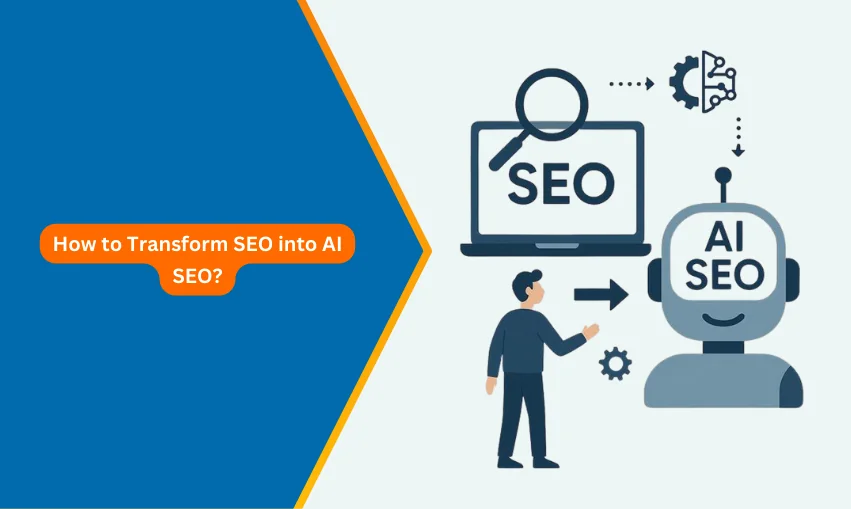
While the rules of Google were not changed and rewritten overnight, over the course of time, many shifts have taken place, which have caused Google to adapt and change. Instead of showing links, it now answers the query directly in a complete manner – summarizing, comparing, and predicting.
Traditional SEO taught us how to optimize for algorithms. However, now, the algorithms are not just ranking, but reasoning. Google has introduced new features, like AI Overview and AI Mode, and the usual SEO strategy won’t work because most people don’t even open the links.
According to Pew data, around 58% of users conducted at least one Google Search query that generated an AI summary. And in only 8% of the searches, the users clicked on a traditional search result with an AI summary, which is nearly half the 15% click rate of pages without an AI summary.
Users are more likely to abandon a page with an AI Overview (26%) than without one (16%). This is an alarming shift, and businesses need to adapt and transform their SEO into AI SEO.

See How Our Experts Can Drive More Traffic to Your Website!
SEO: Boost your rankings and drive more organic traffic today!
Website Design/Development: Create a stunning website that converts visitors into customers.
Paid Media: Reach the right audience at the right time with expertly managed paid media.
Why Traditional SEO Tactics Aren’t Enough?
While traditional SEO is still relevant, it is insufficient on its own. For brands to thrive in an AI-first era, they must move toward cross-channel exposure and structured authoritative content. Here’s how using traditional SEO might not be working for you:
- Since Google’s algorithms now include user intent and the content’s entire context in addition to keyword frequency, keyword stuffing is no longer relevant.
- Backlinks of poor quality, once a quick way to improve search engine rank, can now lead to penalties that seriously harm a site’s visibility and trust.
- Google’s sophisticated algorithms, such as BERT and RankBrain, prefer content that naturally and meaningfully answers user queries rather than overly wordy language.
- Since a single, trustworthy backlink is worth significantly more than hundreds of low-quality ones, link-building tactics must now prioritize getting high-quality, authoritative links.
- Because users often explore their answers instantaneously in knowledge panels, featured snippets, or other on-page results without having to navigate through to a website, the development of zero-click searches has decreased organic traffic.
Additionally, following AI integration, 68% of SEO experts report improved ranks and performance. The AI SEO services in the USA assist businesses in creating such content intelligently and at scale to stay visible, trusted, and preferred by both AI systems and customers.
AI SEO: Does It Make Any Difference?
AI SEO means integrating machine learning, natural language processing, and large language models into search engine optimization strategies. This means that marketers and the SEO team can automate core processes of SEO, like keyword research, content creation, on-page optimization, and technical SEO, using the AI-powered tools.
These tools help understand patterns and aspects in search behavior that humans might miss. Besides, they can expand the coverage of keywords that the team targets.
AI is transforming more than simply SEO. The guidelines for digital visibility are being rewritten. Businesses must abandon keyword-centric strategies as algorithms get more sophisticated to stay competitive. Here’s how artificial intelligence is reshaping the SEO field:
-
Better And Smarter Algorithms
AI-powered algorithms that give more weight to context, intent, and meaning than just keyword matches include Google’s RankBrain, BERT, and MUM. They examine your content’s sentiment, subtleties, and semantic relationships. To put it another way, content that ranks well nowadays needs to address actual issues in a clear, organized, and pertinent manner in addition to using keywords.
-
Automated On-Page SEO
AI streamlines on-page SEO and AI SEM, guaranteeing schema markup and ensuring that content complies with search intent by automating the production of meta tags. It facilitates better ranking opportunities, quicker indexing, and increased user engagement by lowering manual labor. Many AI tools provide better structured data, title tags, and meta descriptions, which increase clicks and speed indexing.
-
Your Gateway To Information
To find keywords, AI looks at what people want and what the competition is doing. AI algorithms can look at search info to help you guess what’s coming next and find good keywords before others do. Programs like Ahrefs’ AI Search Intents group keywords by what users want, like buying something or finding info. This helps make sure your content gives people what they’re looking for.
-
Win Google’s Trust With E-E-A-T
AI is helpful, but it’s not a replacement for people. Content needs to meet Google’s E-E-A-T standards, which are experience, expertise, authoritativeness, and trustworthiness, to really connect with people and do well in search results. As search engines change and start showing AI results directly, companies need to combine AI with human ideas and good SEO. Brands that do well are the ones that are unique, good, and believable.
Transforming from SEO to AI SEO: The Implementation
While we understand what needs to be done to switch from SEO to AI SEO, we forget the most important part: How to? So, here is the implementation guide for you:
-
Start by creating topic clusters
For prioritizing semantic search and structured content, you need to start by creating topic clusters. Comprehensive topic clusters cover all the aspects of a subject. For example, if your core topic is Home Workouts, then the following can be the supporting clusters:
- Strength training without equipment
- Yoga and flexibility routines
- Cardio workouts at home
- Nutrition tips for fitness
Each of these clusters links back to the main pillar page on Home Workouts, giving search engines a clear map of expertise and helping users explore the topic in depth.
-
Deploy an AI-powered content strategy.
Think of AI as your assistant that could help in building solid outlines and briefs. With its features and capabilities, AI can uncover untapped opportunities through entity mapping and semantic clustering. The outlines can include entity relationships that will help the writers to understand the context and build content accordingly. These tools can accelerate ideation while keeping the human strategy at the core. While using AI for your content strategy, ensure that your focus remains on exploring three things: topic depth, intent coverage, and multi-modal relevance.
-
Use AI to expedite content creation, not the writing process.
Generative AI tools are adept at generating unique and SEO-optimized content because all you need is a solid and well-thought-out prompt, and you get your desired results. However, it lacks two important components: human expertise and natural language (conversational tonality). These two can only be achieved when human writers work on the drafts.
Content written in natural language receives 37% more engagement in voice and search results. The AI algorithms can easily understand whether the content is written by a human or a machine. Since they rely on information to generate results, they are more likely to refer to blogs where the content is conversational (understandable), contextually rich (insightful), and directly answers user intent with clarity and depth.
-
Create a proper structure for the content.
To ensure that AI understands your content and the context, it needs to be properly structured. That’s why, before proceeding with writing, create outlines with H2s for main topics and H3s for subtopics. Ensure that every heading (H2s and H3s) has a keyword in it so that AI can recognize the hierarchy, map relevance between sections, and surface your page more accurately for related search queries.
Make the content more insightful by adding information-rich tables, lists, and comparison sections. These content blocks are structured, scannable, and featured-snippet-friendly. It breaks down the complex information into easy, digestible bits, which boosts usability, comprehension, and engagement.
-
Focus on optimizing schema markup.
Schema markup is nothing but structured data. It contains information that provides explicit context to search engines and AI systems about your content’s meaning and relationships. So, implement core schema types for all content, or at a minimum, use the common ones, like Article, Product, FAQ page, How to, and VideoObject for appropriate pages. You can even combine different schemas to provide maximum context.
You can use a schema generator, like Structured Data Markup Helper by Google or Schema Markup Generator by Markle. Once it is generated, you can add the schema markup to your webpage’sortag within the structural HTML file for each page.
Create entity connections through schemas by using properties like mentions, about, and SameAs. Content with an interconnected entity schema is 51% more likely to appear in knowledge panels and an AI-generated overview.
-
Work on technical SEO, not for search engine crawlers, but for AI crawlers.
The AI crawlers work different from search engine crawlers. Googlebot ranks and indexes websites using signals like relevance, authority, and UX, but AI crawlers gather text to get more information to train and inform models. So, they don’t rank pages; rather, they trust pages with unique, valuable, relevant, and verified information.
Large language models, or LLMs, rely on website information for output generation. However, they face a critical limitation, which is that their context window is too small to handle most websites in their entirety.
Websites contain ads, navigation, and JavaScript, which is difficult for the LLMs to browse and convert into LLM-friendly plain text. So, one way to do it is by adding an llms.txt file. Just like you create a robots.txt file for search engines, similarly, the llms.txt file establishes guidelines for AI models, specifying which content on the website should be processed for training and response generation.
-
Audit your website on the basis of Core Web Vitals
Core Web Vitals includes the important metrics that you need to track. It shows where you stand right now, what parts of your website need improvement, and what solid changes you can make to have a huge impact. Core Web Vitals consist of the following metrics:
- Largest Contentful Paint (less than or 2.5 seconds): It measures how much time the largest visible element on your website (like an image, video, or text block) takes to load and becomes visible to users.
- Interaction to Next Paint (less than or 200 milliseconds): It measures the time how quickly for your site to respond (the next frame becomes visible) to user input (like click, tap, or key press).
- Cumulative Layout Shift (less than or 0.1): It measures the visual stability of your page by tracking how much content shifts unexpectedly during the browsing experience.
If you metrics are less than maximum threshold, then your website is performing well on Core Web Vitals. You can use the tools, like Google’s PageSpeed Insights Tool, to run synthetic test and understand your website’s performance. The reports can help in identifying crawlability blocks that are block AI or search engine visibility, and you can convert audit insights into prioritized plans.
Summing Up
Businesses must understand how to create an AI-driven digital strategy to accomplish more with less time and effort. Our Advanced AI SEO for businesses packages show you how to use AI to research and create content, and when combined with our AI digital marketing services, you gain a complete solution for growth and visibility. You’ll also learn how to support and improve your digital marketing and use tools for SEO, social media, and PPC. Our professional SEO agency will create an AI-driven digital strategy that boosts your business planning and increases efficiency at every point of the journey.


