


Even great content fails to rank on search engines and get features in AI results if the search engine and AI bots fail to understand what the content is all about. But the thing is that search engines and AI do not read like humans. They do not infer context, intent, or hierarchy the way we do.
Instead, they rely on structure, signals, and explicit definitions to process information accurately. Search engines and AI need a little help in understanding what your content actually means, and this is where Schema Markup comes into the picture.
Schema provides a structured framework that tells search engines and AI answer engines exactly what your content is about, how different elements relate to each other, and which parts deserve special treatment. So, let’s understand in detail what Schema Markup is all about in SEO and AEO, and how to implement it.

See How Our Experts Can Drive More Traffic to Your Website!
SEO: Boost your rankings and drive more organic traffic today!
Website Design/Development: Create a stunning website that converts visitors into customers.
Paid Media: Reach the right audience at the right time with expertly managed paid media.
What is Schema Markup?
Schema Markup is a structured data or type of code embedded in your webpage’s HTML to assist search engines in interpreting your content better and display additional details in search results, like star rating, prices, or whether a product is in stock or not. These enhanced results are called rich snippets.
The additional details in the Google search results help users to find valuable information directly from the search results page. It helps in navigating the user’s journey. However, it is important to know that adding schema markup does not guarantee rich results. It is upto Google or an AI search engine to decide whether it wants to show rich formats.
That’s why it is better to hire SEO experts instead of taking a do-it-yourself approach to ensure efforts lead to correct schema selection, precise implementation, and measurable gains in visibility across search and AI-driven results.
Example of Schema Markup in Action
Without schema markup, your page will probably show up as a simple blue link. However, if you have implemented schema markup, additional details will be visible as well.
The additional details like store rating, price range, delivery, and return timeline are all automatically pulled from Schema Markup and displayed directly within search results, helping users evaluate options before even visiting the website.

Importance of Schema Markup in SEO and AEO
Schema markup in SEO is a critical component if you want search engines to understand your content. Here’s how it benefits:
- Improved search visibility: Rich snippets increase the visibility of your content in search results.
- Higher click-through rates: Eye-catching details about your webpage, even before the user has opened your website, increase the chances of clicking your link.
- Better UX experience: Since users can see key information immediately on the search result page, they can use it to decide if your page meets their needs.
Besides, with the introduction of AI-powered search engines, like ChatGPT and Gemini, the schema markup helps in AEO (Answer Engine Optimization). These search engines are based on LLMs (Large Language Models), and they use the structured data to provide complete answers to user queries.
So, when you label your content with structured data, you increase your chances that these models will pull out information from your webpage when generating an output. There are several AI-driven search models that use schema markup to present direct answers.
Does Schema Markup Help with Ranking?
Regarding ranking, Google has never stated that schema markup directly affects ranking, but indirectly, it definitely supports website performance on search engines. A schema is vital to guarantee accurate content interpretation and visibility.
So, when search engine bots and AI systems can clearly identify what a page represents, they can associate it with the right queries, entities, and intent. This clarity improves eligibility for rich results, enhanced snippets, and AI-generated answers, which in turn increases visibility, click-through rates, and engagement signals.
Schema markup has an impact on how content is understood and surfaced, and this makes it a critical component of modern SEO and AEO strategies.
Schema Markup Has Evolved, but Adoption Has Not
Schema.org is the markup standard founded by Google, Bing, and Yahoo in 2011 with 297 content types. Now, the set has been expanded to 811 classes, and Google actively works to bring more content types into the mix.
For example, Google tried to bring shipping information into the schema markup and officially introduced it in September 2020. The OfferShippingDetails is nested under the offer type under the Product schema, and it enables merchants to display shipping costs and estimated delivery times in rich snippets on mobile devices in the US.
As of 2024, there are approximately 193 million active sites, and more than 45 million websites use schema. More than 72% of the websites on the Google first page search results use schema.
However, the key thing to note here is that most of the schema markup that is implemented consists of basic types, like FAQ, organization, product, and article. Since there are 811 classes, it means that teams have barely scratched the surface.
Now, the problem is that when everyone uses the same basic schema types, structured data stops being a differentiator. Professional SEO services can help in implementing more specific and nested schemas that provide deeper context to search engines and AI systems. This approach reduces ambiguity, improves eligibility for advanced rich features, and strengthens AEO performance by helping machines interpret content with greater precision.
Types of Schema Markup (Important Ones)
There are dozens of schema markup types, but you don’t need to use all of them, rather only the relevant ones. So, here is a table which mentions the important ones that you can consider:
| Schema Markup Type | What it is? | Common Properties |
|---|---|---|
| Organization | For businesses, schools, and institutions to strengthen their digital presence | Telephone number, address, and URL |
| Local Business | A subtype of Places and Organizations for places of businesses, like a restaurant or a bank | Opening hours, price range, and address |
| Review | A subtype of Creative Work to showcase critical reviews about a book, movie, or restaurant | Review rating, review body, and positive notes |
| Article | Another subtype of Creative Work for published writings, like blog posts and news articles | Speakable, word count, and article body |
| Product | A primary type for products and services, like tote bags, guitars, laptops, smartphones, and more | Aggregate rating, size, and color |
| Event | A primary type for event, like concerts, debates, and festivals | Aggregate rating, about, and location |
Schema Markup for AI and SERPs Language and Formats
Schema markup uses a shared vocabulary from Schema.org, and it is added to the HTML, which is the foundational markup that structures webpages.
So, Google supports three main schema markup formats, and here they are:
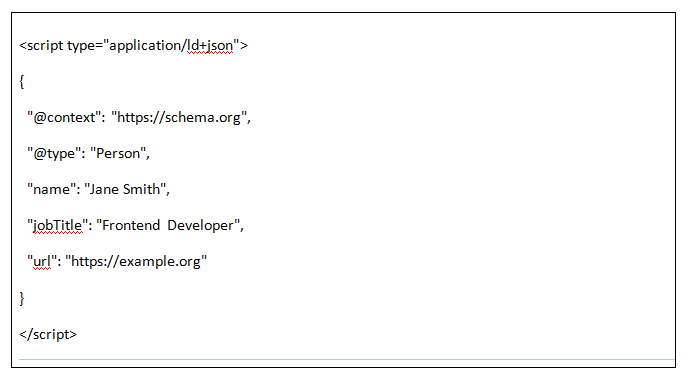
1. JSON-LD
It is a script-based format placed within the script tags in the head or body of your webpage HTML code.
Example:
When to Use?
Suitable for most sites as it keeps HTML code clean and is easy to debug or update.
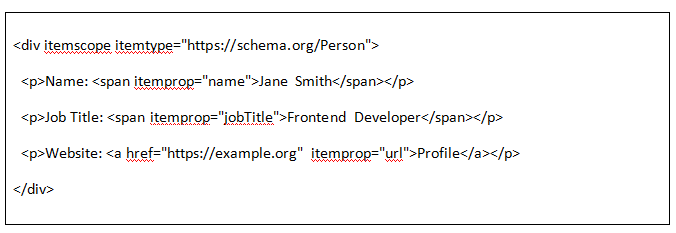
2. Microdata
It embeds the structured data attributes directly into your HTML elements.
Example:
When to Use?
Perfect when you wish for tighter integration with existing HTML content.
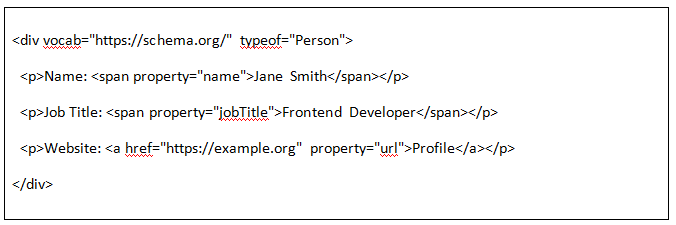
3. RFDa
It uses different HTML attributes, like vocab, typeof, and property, often in div tags to define the relationship within the content.
Example:
When to Use?
Recommended when advanced annotation for linking structured data with semantic web standards is needed.
How to Implement Schema Markup?
If you wish to implement schema markup for both SEO and AEO, then you need to integrate the structured data through HTML code. Here are the steps that you can follow:
Step 1. Decide on Schema Markup Type
Determine which schema markup type you need as per your webpage and your SEO and AEO goals. For example:
- Use Product schema for product pages.
- Use the Article schema for blogs, articles, news, or any piece of information.
- Use the HowTo schema for a guide or step-by-step information.
- Use the LocalBusiness schema to site details about your local business.
- Use Recipe schema for recipes.
- Use the Organization schema to showcase details about an organization or enterprise.
If you are still confused or unable to find the right schema type, then SEO and Answer Engine Optimization (AEO Services) experts can help you.
Step 2. Generate the Schema Markup
Choose a format from the three popularly used formats. However, Google prefers JSON-LD format, and it is easy to execute and does not affect the content visibility to the users.
Then, you can use Google’s Structured Data Markup Helper, Schema.org Markup Generator, and Merkle’s Schema Markup Generator to create valid schema code.
Step 3. Add the Schema Markup to Your Website
Now, the generated code needs to be embedded within the HTML code. It is essential to follow Google’s Structured Data Guidelines before integration and implement the structured data as-is to avoid spam. Here are the three ways you can do it:
- Manual Integration: Once you have the code, add the JSON-LD script within thesection of the HTML code.
- Automation Integration: Use plugins, like YoastSEO, RankMath, and Schema Pro, to integrate the code automatically.
- Dynamic Integration through GTM (Google Tag Manager): If you don’t have time to update the code manually, then you can set up GTM to update it dynamically.
Step 4. Test Your Code
You can use tools, like Google’s Rich Results Test or Schema Markup Validator, to audit and see its appearance in Google search results. It is recommended to use Search Console to see if there are any errors or warnings in schema markup. If you want, you can use A/B testing to see which two versions of the schema markup perform better.
The Bottom Line
Schema Markup plays an important role in AEO and SEO because it makes your content easily accessible to search engines and LLM bots. So, when these entities understand your content better, they can more accurately classify it, match it to relevant queries, and surface it across rich results, featured answers, and AI-driven responses, leading to stronger visibility and more qualified traffic.
If you need any help in implementing schema markup, connect with SEO/AEO experts at Icecube Digital to streamline the implementation.


