

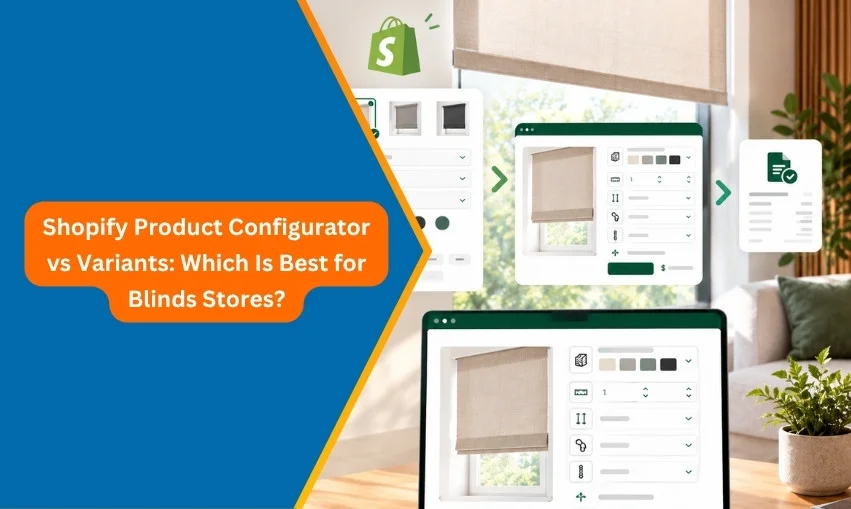
On a blinds store, a Shopify product configurator works as the order form. The customer chooses a fabric, enters the window size and picks the controls, and the price updates with each step. Shopify’s built-in variants cover part of that job. The trouble starts when a store assumes they cover all of it, or swings the other way and pays for a custom build it didn’t need.
This article is written for blinds businesses that already sell on Shopify or have decided to. Still undecided on the platform itself? Then start with this comparison of the best ecommerce platform for blinds, where Shopify is reviewed alongside WooCommerce and Magento. The rest of this article goes through variants first, then apps, then custom builds, and ends with four questions to help you choose.

See How Our Experts Can Drive More Traffic to Your Website!
SEO: Boost your rankings and drive more organic traffic today!
Website Design/Development: Create a stunning website that converts visitors into customers.
Paid Media: Reach the right audience at the right time with expertly managed paid media.
How Do Shopify Variants Work for Made-to-Measure Blinds?
Variants come built into every Shopify store, and for the right products they’re hard to beat.
Shopify Options vs Variants: What’s the Difference?
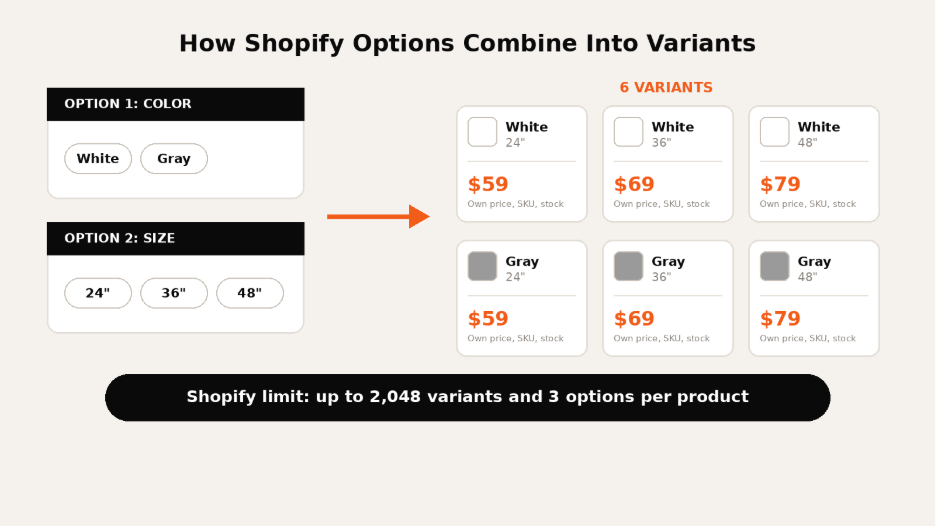
Shopify uses two terms here. An option is something the shopper chooses, like color or size. A variant is one finished combination of those choices. So a white blind at 36 inches is one variant, and a gray blind at 48 inches is another. Each variant can have its own price, SKU, stock level and photo, and Shopify sells and tracks it like a separate item. For products that only come in a few fixed versions, this works well.
What Is the Shopify Variant Limit in 2026?
For years the ceiling sat at 100 variants per product. Shopify has now lifted the Shopify variant limit to 2,048, with big catalogs like furniture, sold in lots of sizes and finishes, clearly in mind. What Shopify left alone is the option count. It’s still three per product. So you could set up fabric, color and size as options. Adding mount type or control side would mean a fourth option, which Shopify doesn’t support without an app or custom code.
Why Made-to-Measure Blinds Outgrow Shopify Variants
A typical made-to-measure roller blind needs at least six answers from the customer before it can be made: fabric, width, drop, mount type, control side and control type. Motors, cassettes and blackout linings are often extra choices on top. That is already more than three options.
Size creates a second problem. Sell widths from 20 to 80 inches in half-inch steps and there are 121 of them. Pair that with 121 drops and one fabric alone has 14,641 size combinations, roughly seven times Shopify’s ceiling. People buying custom blinds also want to type the size they measured rather than scroll through a list. That’s why blinds stores tend to keep variants for part of the catalog and price made-to-measure lines some other way.
When Are Shopify Variants Enough for a Blinds Store?
Variants are still useful in almost every blinds store. There’s no extra app to pay for, and they plug straight into discount codes, stock tracking and Shopify’s sales reports.
Ready-Made Blinds in Standard Sizes
Stock sizes are the obvious case. Say a ready-made roller blind is sold in 24, 36, 48 and 60 inch widths. You’d set up four variants, one per width, each with its own price and stock count. The shopper taps one, and nothing needs calculating.
Fabric Samples, Accessories and Spare Parts
The same goes for anything nobody measures: fabric swatches, remotes, brackets, pull chains and replacement parts. Their prices never change with size. Even stores running a full custom configurator for their blinds tend to sell these as ordinary Shopify products.
Small Ranges With Fixed Size Options
A store with a limited range, for example six fabrics available in five preset sizes, can usually stay within Shopify’s limits. Three options, sensible numbers and no measuring: under those conditions, variants are the least work to run. A lot of stores leave fixed-size lines on variants and send made-to-measure products through a configurator.
Shopify Custom Product Options Apps: What They Can Do for Blinds
Most blinds stores that outgrow variants install a Shopify custom product options app from the Shopify App Store. The app adds extra fields and pricing rules to the product page and leaves your existing variants as they are.
Adding More Than 3 Options to a Shopify Product
The most common reason blinds stores use an options app is to go beyond the three-option limit. A Shopify configurator app can add fields such as mount type, control side, control type, valance style and add-ons. These are saved as additional selections on the order rather than as new variants.
Measurement Fields and Conditional Logic
Options apps also allow customers to enter their own width and drop, which standard variants can’t support. Most include conditional logic, which shows or hides a field based on earlier choices. For example, a motor option can be shown only for blinds above a certain width, and a cassette option only for compatible fabrics. This keeps the product page shorter and reduces orders for combinations that can’t be produced.
Using a Shopify Price Calculator App for Width and Drop Pricing
For blinds, the most important feature is pricing by size. A Shopify price calculator app can use a width and drop price grid, or a price per square foot, to update the total as the customer enters their measurements. This works well for stores with a moderate range, standard supplier price grids and a simple ordering process. For a detailed comparison of pricing methods, this guide to choosing a made to measure pricing calculator explains price grids, area pricing and option rules.
Where Shopify Configurator Apps Reach Their Limits
Because apps are designed for many different types of stores, they don’t always match how blinds businesses price and produce orders. Where we see apps struggle is with separate price grids for each fabric band, rules that depend on size, and order details that need to match a production sheet. Stores sometimes add a second or third app to cover these, which raises the monthly bill and puts more code on every product page.
When Does a Custom Shopify Product Configurator Make Sense?
A custom Shopify product configurator is built specifically for one store’s products, pricing and production process. It makes sense once your team spends time working around app limits, or once pricing mistakes start costing real money.
Fabric Price Bands and Complex Pricing Rules
Many blinds businesses price by fabric band, add surcharges above certain sizes, limit motors to specific products and set minimum order values. A custom configurator can apply all of these rules exactly. When a supplier sends an updated price list, the new prices follow the same rules across the whole range.
Production-Ready Orders for Your Factory
Factories rarely accept orders in just any layout. Each one has its own preferred format, often a template listing width, drop, deductions, control side and options in a set order. A custom configurator can produce orders in exactly that format and, where the manufacturer allows it, send them over automatically. Nobody has to copy order details out of Shopify admin by hand. This handoff between the website and production is a big part of blinds product configurator development.
Trade and Retail Pricing in One Configurator
Plenty of blinds businesses sell to homeowners and to designers, installers or dealers at the same time. With a custom configurator, trade accounts log in and see their own prices on the very same products, so there’s one catalog and one set of rules to keep up to date.
A Configurator Designed for Your Brand and Mobile Shoppers
A custom configurator is built to look like the rest of your store, using your own wording, colors and step order. Mobile deserves extra care here. Many customers measure the window and order on their phone in the same visit, so the configurator needs large input boxes, only a few steps and a price that’s always visible on screen.
How a Custom Shopify Configurator Works Behind the Scenes
Technically, most custom configurators are built on Shopify’s own features. Fabric bands and size limits sit in metafields. The customer’s choices are saved on the order as line item properties, so your team can see them in Shopify admin. The method used to pass the final price to the cart and checkout depends on the store’s Shopify plan and its pricing rules.
Shopify Variants vs Configurator Apps vs Custom Configurator: Side-by-Side
The table shows the main differences for made-to-measure blinds.
| # | Shopify Variants | Configurator App | Custom Configurator |
|---|---|---|---|
| Best for | Ready-made sizes, accessories and samples | Moderate ranges with standard pricing grids | Large ranges with complex pricing and production needs |
| Custom measurements | Not supported | Supported | Supported |
| Options per product | Up to 3 | Many extra fields in most apps | Built to your requirements |
| Pricing by size | Only through fixed size variants | Grid or area pricing in many apps | Any pricing rules you use |
| Setup time | Fastest | Quick | Longest |
| Ongoing cost | Included in your Shopify plan | Monthly app fee | One-time build plus maintenance |
| Order details | Standard variant data | Depends on the app | Formatted for your factory |
What to Plan For: Page Speed, Costs and Ongoing Updates
Before choosing, also think about site speed, ongoing costs and how easy it will be to keep prices up to date.
How Apps and Custom Code Affect Page Speed
Every app you install adds its own scripts to the product page. With one app, the effect on speed is usually small. With three or four on the same page, mobile visitors may notice the page loading more slowly. A custom configurator includes only the code your store uses, so speed is easier to control.
Monthly App Fees vs a One-Time Configurator Build
Apps have a lower starting cost but charge a monthly fee. A custom build front-loads the cost, and after launch you’re mostly paying for maintenance. Run the numbers over two or three years and several app subscriptions can end up costing as much as building your own. If you’d like help with that math, a team offering Shopify development for blinds stores can price both routes against your actual range.
Updating Prices, Fabrics and Options Without a Developer
Suppliers change their prices and add new fabrics, so ask early how updates will work. Can your team upload a new price grid on its own? Can they add a fabric to a band or remove a discontinued color? If each of these needs a developer, the yearly running cost goes up.
How to Choose the Right Shopify Setup for Your Blinds Store
These four questions will help you decide.
Start With Your Product Range
Mostly stock sizes, accessories and swatches? Variants should cover it. Mostly made to measure? In that case, include an app or a custom configurator in the plan from the start rather than adding one later.
Map Your Pricing Rules
List the pricing for each product, including grids, fabric bands, surcharges and add-ons. If most products use simple grids, an app will usually be enough. If you have several bands, rules that change with size or separate trade prices, a custom build is likely the better fit.
Check How Orders Reach Your Factory
Follow one order from checkout to the factory. If someone has to retype orders or call customers to confirm measurements, that time is spent again on every sale. A configurator that sends complete orders to the factory removes most of that work.
Plan for Growth and Trade Customers
Then look ahead. Twenty fabrics today could be two hundred in a few years, and trade accounts are far easier to add when the configurator was designed with them in mind. Mixing approaches is completely normal, with variants for samples and accessories and a configurator for everything cut to size.
Conclusion
Shopify handles blinds stores well, and lifting the cap to 2,048 variants opens it up to bigger catalogs than before. For made-to-measure blinds, though, variants rarely cover the whole job. An options or price calculator app suits a simpler range. Once fabric bands, trade pricing or direct factory ordering come in, a custom Shopify product configurator tends to be the better investment.
Whatever you choose, hold it to three tests: every order priced correctly, product pages that load quickly and order details your factory can use without corrections. Icecube Digital helps blinds businesses plan and build exactly this, from blinds and curtains website design and development through to custom configurators. Contact Icecube Digital to discuss your range and which Shopify setup suits it.
Frequently Asked Questions
Can I start with an app and move to a custom configurator later?
Yes. Starting with an app lets you launch sooner and see how customers use your product pages. If your range or pricing later outgrows the app, a custom configurator can replace it. The switch is easier when product data is organized properly from the start.
Do I need Shopify Plus for a custom product configurator?
Not always. Many custom configurators work on standard Shopify plans. Some advanced pricing and checkout features are only available on Shopify Plus, so whether you need it depends on your pricing and how much you want to change at checkout.
Will a custom configurator keep working when I update my Shopify theme?
It should, provided it’s built as an app block or theme app extension. Those live outside the theme’s own code, so they survive theme updates and even a full theme change. A configurator coded straight into the theme is harder to carry over, so ask about this before the build starts.
How do configurator products show up in Google Shopping?
Google Shopping wants one fixed price per listing, so configurator products normally advertise the price of a standard starting size. Whatever that price is, it has to match what a shopper sees on the product page at that size. A mismatch can get the listing disapproved.
Is a Shopify product configurator worth it for a small blinds store?
That depends mainly on how complex your range is, not on how big your business is. A small store with a few fabrics and simple grids can stay on an app for years. A small store dealing with fabric bands, motor rules or recurring pricing mistakes may get value from a custom configurator much earlier.
Can a Shopify configurator handle curtains and shutters as well as blinds?
Yes. A custom configurator can use a different pricing method for each type of product. Blinds can use width and drop grids, curtains can use fabric and fullness calculations, and shutters can be priced by area. Customers order everything through the same process.

About the author
Parth P
E-commerce Consultant & Co-founder
Parth Patel, a skilled E-commerce Consultant and co-founder of Icecube Digital, dedicates his time to producing straightforward yet invaluable content. With a sharp attention to detail and a passion for innovation, Parth focuses on Magento, WordPress, Shopify and other platforms in his commitment to advancing e-commerce solutions.