
ChatGPT advertisements are no longer a distant possibility. On February 9, 2026, OpenAI officially commenced the testing of sponsored placements within ChatGPT for Free and Go tier users in the United States, and the platform has developed swiftly since then. Whether you’re a business owner trying to grasp the implications, a marketer assessing a new avenue, or an agency planning for your clients, this guide encompasses all you need to learn about advertising in ChatGPT in 2026.
We will explore the functionality of ChatGPT ads, their pricing, the current accessibility for users, and the necessary steps your business should take now to get ready.

See How Our Experts Can Drive More Traffic to Your Website!
SEO: Boost your rankings and drive more organic traffic today!
Website Design/Development: Create a stunning website that converts visitors into customers.
Paid Media: Reach the right audience at the right time with expertly managed paid media.
What Are ChatGPT Ads?
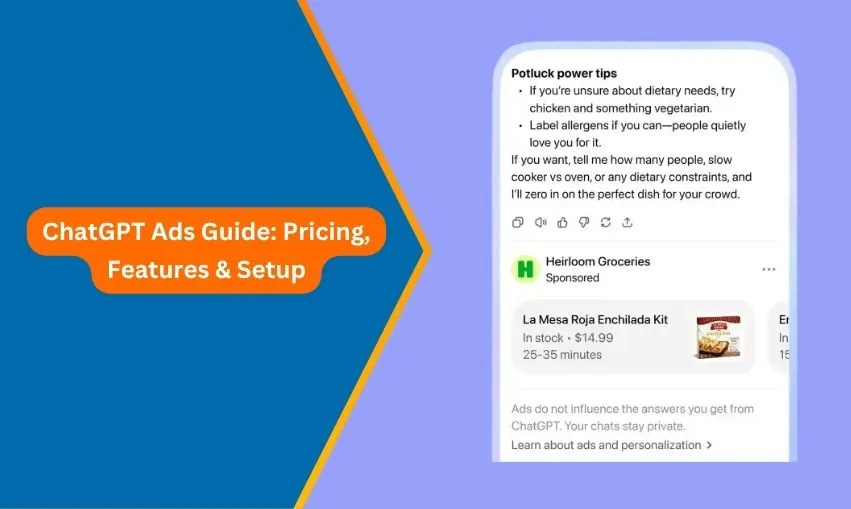
ChatGPT ads are promotional listings that show up beneath the organic AI-generated responses of ChatGPT. They are distinctly marked as ‘Sponsored’ and visually set apart from the actual answer.
In contrast to conventional search ads that are based on keyword matching or social ads that target specific demographics, ChatGPT ads rely on the context of the conversation. The system evaluates the ongoing dialogue in your chat, including the subject matter, your wording, and your intent, to identify and display an ad that is pertinent to that specific moment.
For instance, if you’re discussing a home office renovation with ChatGPT, you might encounter a sponsored ad for a furniture company or a productivity application. The advertisement is not shown due to a keyword bid; instead, it is displayed because the context of the conversation aligns with the targeting criteria set by the advertiser.
Importantly, ads do not influence what ChatGPT says. OpenAI has built a hard wall between answer generation and ad selection. The AI produces its response based entirely on what is most helpful to you. A separate system then determines whether a relevant sponsored unit should appear alongside that answer.
How ChatGPT Advertising Actually Works
Understanding the mechanics helps you plan campaigns more effectively and set realistic expectations.
Who Sees the Ads
Ads are shown only to users on ChatGPT’s Free and Go tiers. Subscribers on Plus, Pro, Business, Enterprise, and Education plans do not see ads. OpenAI has also stated that it will not show ads in accounts where the user is identified or predicted to be under 18.
This matters for audience planning. If your target buyers are power users or enterprise teams on paid plans, your addressable reach on ChatGPT is narrower than the platform’s total user count suggests.
Where Ads Appear
Ads appear at the bottom of ChatGPT responses, in clearly labeled, visually distinct units. Each ad includes a headline, a short description, and a call-to-action button. OpenAI controls which CTA label appears, though advertisers will likely gain more control over this as the platform matures.
How Targeting Works
Ad matching is primarily contextual. By default, the system considers:
- Current conversation topic — the subject of your active chat thread
- General location and language — broad geographic context
- Past chat history — available only if the user has opted into personalized ads
- Previous ad interactions — dismissals and engagement signals
Advertisers do not get access to the content of user conversations. They receive only aggregated performance data such as impressions, clicks, and conversions, never individual dialogue.
Sensitive topics are excluded entirely. Ads are not eligible to appear near conversations involving health, mental health, politics, or any content involving predicted minors.
Can You Advertise on ChatGPT Today?
Yes, and the access landscape has shifted dramatically in just a few months.
When the pilot launched in February 2026, access required a minimum spend of $200,000 and was limited to a small group of enterprise advertisers working through agency partners like Dentsu, Omnicom, Publicis, and WPP.
That changed quickly. By April 2026, the minimum had dropped to $50,000. Then on May 5, 2026, OpenAI launched the beta self-serve Ads Manager at ads.openai.com removing the minimum spend requirement entirely for approved U.S. advertisers.
As of June 2026, the platform has also expanded geographically beyond the U.S., with pilots running in Canada, Australia, and New Zealand, and further market expansion planned through the rest of the year.
If you are outside these markets or waiting on beta access, you can register your interest at openai.com/advertisers.
ChatGPT Ads Pricing: What It Actually Costs
OpenAI’s Ads Manager supports two buying models:
- CPM (cost per thousand impressions) — the original model, suited to brand awareness campaigns. The default maximum bid is $60 CPM, though real-world clearing rates have compressed to as low as $25 in some categories as the platform scales.
- CPC (cost per click) — introduced in April 2026, this model lets you pay only when a user clicks your ad. OpenAI recommends a starting bid of $3 to $5 per click. Bids below $3 tend to see limited delivery.
Both models operate on a relevance-weighted, second-price auction. That means a well-targeted, high-quality ad on a smaller bid can outperform a weak ad with a larger budget.
For context, early B2B advertisers have reported CPCs in the $8 to $15 range for competitive categories, while e-commerce categories tend to fall closer to $3 to $6. These numbers are still settling as more advertisers enter the auction.
In late May 2026, OpenAI also began rolling out cost-per-action (CPA) bidding for select advertisers with conversion tracking configured, a major step toward making ChatGPT a true performance marketing channel.
ChatGPT Ads vs Other Advertising Channels
To understand where ChatGPT advertising fits in your marketing mix, it helps to compare it directly against established channels.
| Feature | ChatGPT Ads | Google Ads | Meta Ads |
|---|---|---|---|
| Targeting method | Conversational context | Keywords + intent | Demographics + interests |
| Ad placement | Below AI response | Search results / Display | Social feed / Stories |
| User mindset | Active research / decision | Declared intent search | Passive browsing |
| Buying models | CPM + CPC | CPC / CPA / CPM | CPM / CPC / CPA |
| Avg. CPC range | $3–$8 | $1–$50+ (varies) | $0.50–$3.50 |
| Ad-free option | Yes (Plus/Pro tiers) | No | No |
| Brand safety controls | Topic exclusions built-in | Keyword negatives / placements | Audience exclusions |
| Conversion tracking | Conversions API + pixel | Mature (GA4, etc.) | Meta Pixel (mature) |
| Platform maturity | Early stage (2026) | Mature (20+ years) | Mature (15+ years) |
The key distinction is user mindset. Google captures declared intent at the keyword level. Meta interrupts passive browsing. ChatGPT reaches users while they are actively constructing, understanding, researching, comparing, and working toward a decision. That context is uniquely valuable, especially for complex or considered purchases.
The trade-off is platform maturity. Google Ads and Meta Ads have two decades of attribution infrastructure, audience tools, and optimization levers. ChatGPT advertising is still in early innings, and your measurement capabilities are more limited for now.
Why the Moment Matters for Businesses
ChatGPT is used by hundreds of millions of people globally. OpenAI reports processing 2.5 billion daily prompts. Within six weeks of launching ads in the U.S., the platform reportedly crossed $100 million in ad revenue, a proof-of-concept that validated significant advertiser demand.
The behavioral shift is real: users are increasingly resolving queries inside conversational AI rather than clicking through search engine results pages. As AI overviews absorb more informational intent on Google and ChatGPT becomes a first stop for research and decisions, advertisers need to meet users where they are going, not just where they used to go.
This pattern mirrors what happened in the early years of Google Ads and Facebook Ads. Early movers who figured out what worked before the auctions matured and CPCs climbed gained a durable advantage. The businesses experimenting with ChatGPT ads in 2026 are building that same kind of first-mover knowledge.
Ad Formats Available in ChatGPT
OpenAI launched with a single primary format and has signaled a more diverse roadmap ahead.
- Conversational sponsored cards — the confirmed live format. A clearly labeled unit appears below the AI response, containing a headline, short description, and CTA button. The ad is visually distinct from the organic answer.
- SearchGPT sponsored results — when ChatGPT functions in a search-oriented mode, sponsored results can appear within those response types, similar in concept to traditional search ads but matched to conversational queries rather than discrete keywords.
On the roadmap, OpenAI has signaled:
- Audience syncing — first-party customer list matching later in 2026
- Multi-turn conversation retargeting — reaching users who engaged with relevant topics without converting
- Additional CTA options and creative controls for advertisers
Who Should Be Thinking About ChatGPT Advertising Now
Not every business is equally positioned to benefit from ChatGPT ads today. The platform is best suited for:
- B2B software and SaaS companies — users researching tools, comparing platforms, and evaluating features are a core ChatGPT use case. High-intent research conversations are exactly where B2B brands want to show up.
- Professional services — legal, accounting, consulting, and marketing agencies serve buyers who research deeply before deciding. ChatGPT is increasingly part of that research process.
- Education and online learning — users exploring courses, certifications, and skill development frequently turn to ChatGPT for recommendations.
- Premium consumer goods — considered purchases with research phases — home improvement, electronics, premium apparel — map well to conversational context.
- Ecommerce brands with clear product-to-context fit — the earlier recipe-to-grocery-delivery example from OpenAI’s own documentation illustrates this well.
Businesses with very short consideration cycles, impulse purchase categories, or highly visual products may find the format less effective in its current state.
How to Prepare Your Business for ChatGPT Advertising
Whether you have access today or are waiting for a broader rollout, this checklist covers the actions that matter right now.
- Register at openai.com/advertisers to join the waitlist and stay updated on access availability in your region.
- Audit your website’s conversational content — does it answer questions the way a real user would ask ChatGPT?
- Build a GEO content strategy — create pages and blog posts that AI models can easily cite and surface.
- Rewrite ad copy in a helpful, informative tone rather than aggressive sales language (OpenAI enforces this).
- Prepare a high-converting landing page that matches the conversational intent of your ad.
- Set up the Conversions API and pixel tracking now, so your measurement is ready when your account goes live.
- Define your campaign objective: brand awareness (CPM) or direct response (CPC).
- Identify your top 10 conversational topics that relate to your product or service category.
- Set a realistic test budget — early self-serve campaigns can start without a spend minimum.
- Research brand safety exclusions to ensure your ads avoid sensitive topics where placement is restricted.
- Align your team on what success looks like: CTR, cost per lead, or influenced revenue.
- Monitor OpenAI’s ad policy updates regularly, as the platform is evolving quickly.
Expert Tips: What to Do Right Now
These are practical moves any business can make today, regardless of whether they have direct access to the platform.
Think in Conversations, Not Keywords
ChatGPT ads are matched to the semantic context of a conversation, not a keyword bid. Before you write a single line of ad copy, ask yourself: what is a ChatGPT user actually asking when they are close to buying what I sell? Build your targeting around those conversation moments.
Treat Your Landing Page as Part of the Ad
A user clicking a ChatGPT ad has been in the middle of a thoughtful, research-oriented conversation. They are not in passive-scroll mode. Your landing page needs to meet that expectation clearly, informatively, and relevantly to what they were just discussing. A generic homepage will waste the click.
Set Up Conversion Measurement Before You Spend a Dollar
OpenAI launched a Conversions API and pixel-based tracking in May 2026. Install these now, test them, and make sure your attribution is ready. The advertisers who enter ChatGPT with measurement in place will have an enormous data advantage over those who add it after the fact.
Write Ad Copy That Helps, Not Sells
OpenAI enforces guidelines requiring ads to be useful and non-disruptive. Aggressive sales language, superlative claims, and high-pressure CTAs are more likely to be rejected or ignored. Frame your value proposition as an answer to what the user is looking for, not as an interruption.
Start with CPC, Not CPM
For most businesses entering the platform, CPC buying aligns spend with genuine user interest. CPM campaigns make more sense when your goal is brand awareness at scale. If you are testing the channel for the first time, CPC lets you measure traffic quality before committing larger budgets.
Use GEO Content Strategy as a Force Multiplier
Even without paid access, every business can invest now in Generative Engine Optimization (GEO), creating content that AI models can easily surface, cite, and use as sources. Brands that show up organically in ChatGPT responses are already building visibility that paid ads can then amplify. Agencies like Icecube Digital have been building GEO strategies alongside traditional SEO for clients who want to maintain visibility across both search engines and AI platforms.
Challenges and Limitations to Understand
ChatGPT advertising is genuinely exciting, but going in with clear eyes matters.
- Limited reach within the user base — only Free and Go tier users see ads. Heavy users and professionals on paid plans are excluded.
- Measurement is still maturing — the Conversions API and pixel launched in May 2026, but third-party measurement integrations are still in development. You are partly marking your own homework for now.
- Click-through rates are lower than search — early data suggests CTRs run roughly 7 to 10 times lower than Google Search. Conversion quality appears higher, but you need meaningful volume to evaluate performance fairly.
- Creative guidelines are strict — OpenAI verifies each advertiser and reviews ad creative. Ads must align with platform guidelines around helpfulness, accuracy, and topic restrictions.
- Geography is still limited — as of mid-2026, the platform is live in the U.S., Canada, Australia, and New Zealand. Global advertisers will need to wait for further market rollout.
What the Rest of 2026 Looks Like for ChatGPT Advertising
The advertising roadmap OpenAI has signaled, audience syncing, multi-turn retargeting, CPA bidding, and additional creative formats map to a platform that will closely resemble the performance marketing infrastructure of Google and Meta within 12 to 18 months.
Google is preparing Gemini ad integration to compete. Microsoft already runs sponsored answers inside Bing Copilot. Perplexity AI is testing native ads. The AI advertising ecosystem is forming fast, and 2026 is the year the foundations are being laid.
OpenAI’s expansion from a $200,000 minimum enterprise-only pilot in February to a no-minimum self-serve platform by May happened in under 90 days. That pace tells you something about the commercial opportunity and about how fast this channel will evolve.
For marketers, the opportunity is clear: learn the platform while it is new, build first-party data and measurement infrastructure, and develop the conversational creative skills that will define success in AI advertising because this shift is only going to accelerate.


