

You may be driving steady traffic to your Shopify store, yet sales aren’t growing as quickly as expected. Visitors browse products, add items to their carts, and then disappear. In most cases, the issue isn’t pricing or product quality it’s hidden friction. Slow page loads, confusing navigation, weak trust signals, or an overly complex checkout process quietly push high-intent shoppers away.
By 2026, these small issues compound rapidly, turning valuable traffic into lost revenue. As competition intensifies and user expectations rise, even minor usability gaps can significantly impact conversions.
This CRO Checklist for 2026 is designed to help you identify and fix those issues systematically. Instead of relying on guesswork, this guide walks you through the critical areas every Shopify store must audit from UX and performance to messaging and checkout to uncover conversion leaks, remove friction, and create a shopping experience that consistently turns visitors into customers.

See How Our Experts Can Drive More Traffic to Your Website!
SEO: Boost your rankings and drive more organic traffic today!
Website Design/Development: Create a stunning website that converts visitors into customers.
Paid Media: Reach the right audience at the right time with expertly managed paid media.
Understanding CRO (Conversion Rate Optimization)
Conversion Rate Optimization (CRO) is the process of improving your Shopify store so that a higher percentage of qualified visitors complete a purchase. By 2026, CRO goes far beyond simple button tests or layout tweaks. It has evolved into a holistic discipline that combines user experience design, performance optimization, data analysis, and trust-building elements.
Modern CRO focuses on understanding how users interact with your store, leveraging artificial intelligence to automate personalization, and reinforcing trust at every stage of the buyer journey. Working with a conversion rate optimization agency helps ensure these strategies are implemented effectively, making shopping effortless, intuitive, and reassuring.
Search engines are also paying close attention to user behavior. Stores that provide clear information, fast performance, and seamless experiences are more likely to convert and rank higher in search results as a result.
Key Elements of CRO
- A high-performing Shopify CRO strategy includes:
- User Experience (UX): Clear navigation, easy product discovery, and intuitive usability
- Performance Optimization: Strong Core Web Vitals, fast load times, and responsive design
- Personalization: AI-driven recommendations and dynamic content
- Trust Signals: Reviews, security indicators, transparent policies, and social proof
- Data & Testing: Heatmaps, analytics, and continuous experimentation
When combined, these elements increase engagement, improve conversions, and enhance search visibility.
The 2026 CRO Checklist for Shopify Stores
Ensure Mobile-First Optimization
By 2026, mobile-first optimization is no longer optional it’s foundational. Shopify stores are evaluated and ranked based on their mobile performance, not desktop experience.
Your mobile audit should ensure:
- Fully responsive design across all screen sizes
- Large, tappable CTAs and buttons
- Simplified mobile navigation
- Optimized images and readable fonts
No matter the quality of the traffic, if mobile users struggle to browse or check out, conversions will fall.
Google uses mobile-first indexing, making mobile UX critical for both rankings and conversions.
Apply Advanced Personalization Techniques
Personalization is now a baseline expectation, not a competitive advantage.
High-converting Shopify stores leverage:
- AI-powered product recommendations
- Behavior-based homepage and category content
- Personalized email and abandoned cart flows
- Location- and intent-based messaging
Effective personalization streamlines navigation, surfaces relevant products, increases average order value, and creates a shopping experience customers actually enjoy.
Optimize for Voice and Conversational Search
Voice and conversational search are playing an increasingly important role in how shoppers discover and evaluate Shopify stores.
To optimize for voice search:
- Use natural, question-based headings
- Provide clear, concise answers
- Add structured FAQ sections
- Write content the way people naturally speak
This approach improves visibility in Google AI Overviews and Perplexity citations, which favor concise, factual answers.
Streamline the Checkout Process
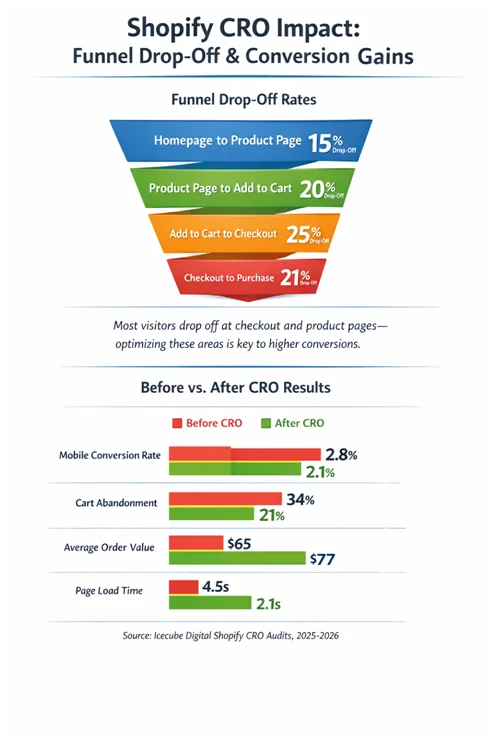
Checkout friction remains one of the biggest causes of cart abandonment. Long forms, unexpected costs, and unnecessary steps discourage users from completing purchases.
A Shopify checkout ready for 2026 should include:
- Guest checkout options
- Express payments such as Shop Pay, wallets, and BNPL
- Minimal form fields
- Transparent shipping and tax costs
Fewer steps and fewer surprises lead to lower abandonment rates and more completed purchases.
Optimize Performance and Core Web Vitals
Your CRO audit must also address performance metrics, including:
- Largest Contentful Paint (LCP)
- Cumulative Layout Shift (CLS)
- Interaction latency
- App bloat and unused scripts
Fast Shopify websites retain users longer, convert at higher rates, and perform better in AI-powered search results. Performance optimization for Shopify stores directly impacts engagement, conversions, and keyword visibility.
Upgrade Your Visual Content
Visual clarity plays a major role in purchase decisions. Shoppers are far more likely to buy when they can clearly see and understand a product.
In 2026, Shopify stores should prioritize:
- High-quality product images
- Short demo and explainer videos
- Lifestyle imagery that shows real-world use
- Consistent visual branding
Strong visuals reduce hesitation, speed up decision-making, and increase confidence in purchases.
Boost Engagement with Interactive Elements
Interactive elements improve engagement and reduce decision fatigue by helping users make choices more easily.
Effective CRO-driven interactions include:
- Product recommendation quizzes
- Size and fit calculators
- Expandable FAQs
- Interactive comparison tools
Higher engagement sends positive user signals to search engines and directly improves conversion rates.
Focus on Sustainability and Ethical Practices
Sustainability is no longer just a branding statement—it directly influences purchasing decisions.
Consumers increasingly look for:
- Ethical sourcing information
- Eco-friendly packaging
- Carbon-neutral shipping options
- Transparent brand values
Clear sustainability messaging builds trust and resonates strongly with younger, values-driven audiences.
Use Advanced Analytics and Heatmaps
Data-driven CRO focuses on understanding how users actually behave on your website.
Your analytics stack should include:
- Funnel analysis
- Scroll and click heatmaps
- Session recordings
- Conversion path tracking
These insights reveal friction points that traditional metrics often miss, enabling smarter optimization decisions.
Continuously Test and Optimize
CRO is an ongoing process, not a one-time task.
High-performing Shopify stores:
- Run continuous A/B tests
- Optimize copy, layouts, and CTAs
- Monitor performance after Google updates
- Adapt based on evolving user behavior
Ongoing optimization keeps your store competitive in rapidly changing search environments.
Conclusion
To stay competitive, Shopify stores must continuously optimize their user experience as search behavior and customer expectations evolve. Long-term success in 2026 won’t come from driving more traffic alone it will come from making every visit count.
The Shopify stores that succeed will focus on usability, performance, trust, and personalization, creating experiences that encourage visitors to stay, explore, and buy.
With expert Shopify development services from Icecube Digital, you can build stores that convert consistently, adapt quickly, and grow sustainably.


