


As we get closer to 2026, the eCommerce marketplace is on the rise with new developments and predictions from TikTok Shop to Generative AI and 3D Virtual Shopping Store to Headless eCommerce development. Because of the modern advances in technology and consumers’ interests, the eCommerce industry is advancing with innovative adaptations.
Every year brings new developments and improvements in eCommerce. But for companies, the following year promises to be more intriguing and profitable as new trends are set to transform this industry. According to Statista, the global eCommerce revenues will reach $5,026 billion at a CAGR of 8.95% between 2024–2028.
Thus, if you are an online retailer or planning to develop an eCommerce website, it is important to examine these emerging eCommerce trends 2026, which are anticipated to transform everything completely.
Top 15 eCommerce Trends to Watch in 2026
Here’s an in-depth breakdown of the top 15 eCommerce trends you need to know as we step into 2026:

See How Our Experts Can Drive More Traffic to Your Website!
SEO: Boost your rankings and drive more organic traffic today!
Website Design/Development: Create a stunning website that converts visitors into customers.
Paid Media: Reach the right audience at the right time with expertly managed paid media.
Artificial Intelligence for Personalization
Ordinary shopping experiences are becoming less frequent. Consumers anticipate personalized eCommerce experiences – to let the stores know what exactly they need. Artificial intelligence (AI) agents make use of predictive intelligence to learn about customer preferences and previous purchase patterns and further bundle this information with generative AI techniques to provide a personalized user response. For eCommerce purposes, companies can train artificial intelligence to adapt to consumer behavior, which will result in more accurate and useful data.
Today, artificial intelligence systems assess:
- Browsing behavior
- Purchase history
- Geo-location
- Engagement patterns
- Real-time intent
These AI eCommerce trends will help deliver dynamic, tailored storefronts.
Examples:
- Advice on goods depending on personality style.
- Homepage designs that change according to the preferences of each visitor.
- Smart product categorization based on the probability of purchase.
Impact: Higher CTR, better conversion rates, higher AOV, and repeat sales.
Headless & Composable Commerce Takes Over
Consumers shop through their phones, apps, smart TVs, social feeds, AR glasses, kiosks, etc. Headless Commerce allows the front-end experience to be decoupled from the backend to provide ultra-fast, highly branded experiences.
The leading platforms that are making headless commerce happen in 2026 include:
- Magento / Adobe Commerce
- Shopify Hydrogen / Oxygen
- CommerceTools
- BigCommerce
- Odoo + React Frontend
Example: Nike wanted a mobile-first e-commerce site to engage the mobile consumer niche better. They needed to optimize every element, even the CTA (call to action) and images that fit on the smaller screens. They used React SPA and a Node.js backend for (BFF) to optimize experiences smoothly across every page.
Impact: Adopting these ecommerce UX trends resulted in faster load times, better UX, and improved core Web Vitals, leading to enhanced SEO & conversions.
Conversational Commerce — Chat, Voice & AI Shopping Assistants
Customers demand immediate responses. AI chatbots and GPT-powered virtual buying aids are replacing contact forms and sluggish email replies. With the help of AI chatbots, users can:
- Ask which product suits them.
- Get size and fitting help.
- Compare features.
- Track orders.
- Buy directly through the chat.
- Voice shopping via Siri, Alexa, and Google Assistant.
Example: Stella chatbot solution used by Toyota gathered the interests of interlocutors through chat conversation, after which the bot allocated users with the relevant team members on live chat.
Impact: Reduced support load + increased checkout success.
Mobile Commerce Dominating Over Desktop
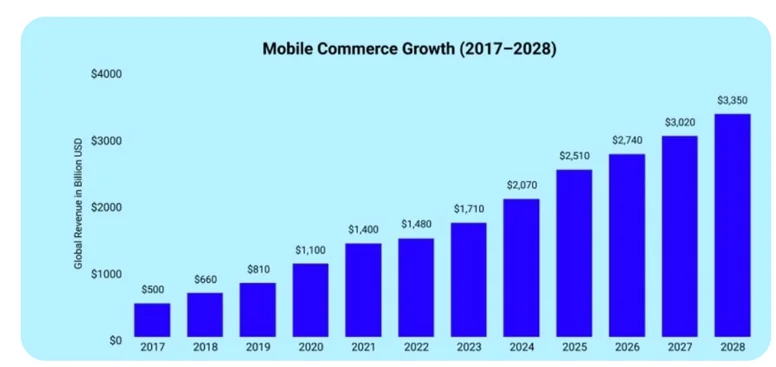
While shopping through mobile devices is not a new trend, it is all set to shine in 2026. With 76% of users already using mobile phones to make eCommerce purchases, the mobile commerce trends 2026 will reach a sale of $2.7 trillion in 2026.
Example: Coursera, an online learning platform that features different video courses and programs from students all over the world, has also designed a mobile app for its customers.
Impact: Around 20% of the platform’s user base accesses the content via mobile devices.
AR, VR & Virtual Try-On Go Mainstream
According to statistics, AR eCommerce experiences are 200% more engaging than non-AR experiences. AR and VR have been very powerful in bridging the gap between offline and online shopping. Using AR and VR in your eCommerce platform can improve brand affinity and increase conversions.
Virtual try-ons are rapidly improving:
| Industry | Experience |
|---|---|
| Fashion | Try clothes & jewelry virtually |
| Furniture | In-room visualization for furniture/fixtures |
| Beauty | AI shade matching for skin tone |
| Eyewear | Real-time frame try-on |
Impact: Reduces return rates dramatically.
Subscription & Refill-Based Commerce Grows
Consumers favor convenience + predictability. Customers have scaled convenience over the years, meaning they have acclimated to shopping online. The subscription model has emerged as one of the major trends in the eCommerce space in meeting consumers’ recurring expenses.
D2C brands in the following industries are moving to auto-refill & subscription packs with the help of eCommerce development services:
- Supplements
- Pet foods
- Personal care
- Baby care
- Tea/coffee
Example: From streaming services to monthly clothing deliveries and daily meal kits, HelloFresh offers many items on subscription. With its adjustable plans, HelloFresh has drawn in more than seven million consumers worldwide as of October 2022.
Impact: Higher Lifetime Value (LTV) & stable recurring revenue.
TikTok, Instagram & Social Commerce Dominate Discovery
In 2026, search traffic will start to shift to social recommendations. According to the latest statistics, approximately 87% of customers use social media to help when making shopping decisions.
Different social commerce platforms that are set to dominate in 2026 include:
- TikTok Shop
- Instagram Shops
- Facebook Marketplace
- YouTube Storefronts
This is a mobile commerce trend 2026 that lets creators have a direct influence on purchase decisions.
Example: Letterfolk, an eCommerce brand that sells home decor and gift items, created an instagram
Impact: Observed increase in sales, social engagement, and the number of followers.
Zero-Party Data Collection is the New Strategy
A Cisco study revealed that 86% of consumers place importance on data privacy – they want businesses to be up front about how they use data and share that data with them.
As privacy measures tighten (GDPR and iOS tracking regulations), brands will no longer have the option to use 3rd-party data solely. In 2026, they will collect data directly from users in the following forms:
- Product preference quizzes.
- Loyalty engagement check-ins.
- Personalized onboarding funnels.
Example: In a recent Google algorithm update, page experience (one of the Core Web Vitals) was added as a ranking signal.
Impact: More relevant marketing, less ad waste.
Live Shopping / Livestream Commerce Explodes
People trust humans, rather than ads. Live streams can become owned revenue moments when:
- Shoppable video is distributed in the form of limited-time bundles.
- Reminders synced into CRM get set for the live stream.
- Schedule drops.
- Hosts hype up the product showcase.
- Viewers ask questions.
- Expect “story-sale” video formats to develop: teach/demo/drop/UGC stitch and limited claim windows.
This is a trend that began in China → is now exploding in the United States and several other countries.
Example: An example of the best live streaming in e-commerce is Alibaba. It popularized live commerce in China, and there has been an explosion in creativity.
Impact: CRM-integrated drops, shoppable replays
Ultra-Fast & Localized Delivery
Customers expect their online purchases to arrive as soon as possible. According to studies, 62% of all shoppers expect free shipping orders to be delivered within three business days. There is a demand for speed, especially in urban and suburban areas. Hyperlocal delivery networks are emerging through:
- Micro warehouses
- City-hub fulfillment centers
- Gig driver fleets
Partners include:
- Amazon Logistics
- Delhivery
- Shadowfax
- UberDirect
- Zepto model networks
Same-day becomes a differentiation factor.
Example: Amazon provides an excellent example of an effective fulfillment strategy. By establishing inventory warehouses throughout the globe, it is able to realize a fast supply chain.
Impact: Inventory management, reduced overstock/understock, and eliminated wastage
Sustainability & Ethical Consumption Become Buying Factors
Sustainability concerns, particularly regarding the environmental impacts of eCommerce, have resonated with many consumers over the years. Consumers, and Gen Z in particular, prefer to buy from brands that:
- Use eco-friendly packaging.
- Run transparent supply chains.
- Support ethical labor.
- Commit to carbon neutrality.
These factors may differentiate trust in brands as we approach 2026.
Example: Thrive Market, an online grocery membership store, sells products that are ethically sourced and delivered in carbon-neutral packaging. The warehouse is even zero-waste.
Impact: Fewer miles, less waste, and better customer experience
AI-Enhanced Fraud Prevention & Security Layers
With the rise of digital commerce, fraud is increasing too. Customers want to know their information is safe, and as expectations for data security grow, brands need to adopt strict protocols to maintain trust. 2026 introduces:
- Device fingerprinting
- Behavioral biometrics
- AI anomaly detection
- Strong OTP + 2FA identity checks
Example: A notable example is Cognizant’s AI-powered fraud detection system, which uses deep learning to analyze transaction data and prevent fraud.
Impact: Immense security leading to customer trust.
Multi-Currency, Multi-Region Expansion = New Standard
When customers encounter prices in their own currency, it removes a significant mental barrier, shifting their focus from conversion calculations to product value. Brands expand globally with:
- Region-based storefronts.
- Local payment methods (Klarna, UPI, Afterpay, Apple Pay).
- Localized language & shipping partners.
It lets you price for different markets based on local economic factors, competition, and buying power.
Examples: Shopify Markets allows you to manage multiple countries through a single store setup, with distinct markets having their own currency settings.
Impact: Reducing friction and conversion rate worries.
Cross-border Selling Becomes Frictionless
Gamification in eCommerce brings the feeling of reward and satisfaction, with 38% of people liking games and 30% more likely to purchase from interactive features. Gamification drives repeat engagement; therefore, businesses should make buying fun:
- Coins & rewards
- Unlockable tiers
- Spin-to-win coupons
- Referral contests
- Purchase milestones
Businesses that gamify buying see much higher repeat orders.
Example: One of the biggest examples of this in real life is the referral programs of applications like Revolut and Wise.
Impact: Customer loyalty, product promotion, brand awareness, and increasing your customer base.
Phygital Retail (Store + Online Together)
The future of ecommerce 2026 is phygital – a combination of online channels and physical retail experiences. This eCommerce model builds on the notion of a transaction that may include multiple channels and platforms to create an enhanced, seamless experience with an end goal of hybrid commerce or omnichannel selling. Hybrid retail incorporates:
- Buy Online Pickup In Store (BOPIS)
- Click-and-collect
- Scan & learn counters
- AR catalog browsing in stores
- Smart kiosks for instant checkout
With this, the line between offline & online disappears.
Example: Leading retailers like Walmart, Target, and IKEA offer this service.
Impact: Immersive, personalized experience.
Conclusion
The future of eCommerce in 2026 is AI-driven, experience-led, hyper-personalized, fast and data-smart, omnichannel, and global. Brands that embrace these trends early will lead their markets. Such trends predict a richer shopping experience for customers while keeping your business healthy.
By prioritizing innovation and working with a reliable Magento eCommerce development company, you can drive growth and meet your customers’ expectations. Icecube Digital understands eCommerce development needs and has been ahead of the curve with strategies built around emerging trends. We provide advanced solutions and have deep experience managing various e-commerce platforms.
Get in touch to take advantage of the eCommerce website design services as you move with the latest eCommerce trends in 2026!


