

As a local business, you must have optimized your website and the content strategy as per the best local SEO strategies. Yet when you search for a keyword that’s clearly relevant to your business, the same few competitors always dominate the top results.
Meanwhile, your brand is buried somewhere down the page, and it’s hard not to feel discouraged. Now, it is not that they are better than you, but they have cracked the code of data-driven local SEO.
Instead of relying on implement, wait, and hope for the best approach, your competitors are building their local SEO strategy on measurable inputs, like real search data, performance insights, and user behavior trends.
This gives them the opportunity to shine on search results because they are aligning every page, post, and listing with what people in their area are actually searching for. If you also wish to appear at the top spots of SERPs for local keywords, you need to master data-driven local SEO, and this blog will help you get started.

See How Our Experts Can Drive More Traffic to Your Website!
SEO: Boost your rankings and drive more organic traffic today!
Website Design/Development: Create a stunning website that converts visitors into customers.
Paid Media: Reach the right audience at the right time with expertly managed paid media.
What is Data-Driven Local SEO?
Data-driven local SEO refers to implementing local SEO strategies refined on the basis of real user behavior, rankings, and conversion data.
If you ask, What is local SEO, then it is the process of optimizing a brand’s visibility in location-based searches on Google.
However, data-driven local SEO changes your go-to approach. Like, you are not just blindly implementing the best practices suggested by local SEO experts or copying your competitors, hoping that it worked for them, so it will work for you.
Rather, you create your local SEO strategy, which is backed by real-world data. You are using hard numbers to make smart decisions such that your business gets noticed by people who matter to your sales and growth.
When you use the data, you can pinpoint exactly what your users search for, what they click, and how they engage with your business. You can see what people search before they find you, how far they scroll, and what finally makes them call or visit.
You can identify the exact touchpoints that drive action and then optimize every step to convert faster and more consistently.
So, when you go data-driven, you are not flying blind; rather, you are following a roadmap built from actual search behavior patterns and search patterns.
What Do Data-Driven Local Search Engine Optimization Strategies Look Like?
Local SEO strategies would be vague; they won’t tell you what exactly needs to be done. In contrast, data-driven local SEO strategies spell it out clearly. They pinpoint which keywords are worth targeting, which pages actually bring traffic, which listings generate calls, and which customer actions lead to conversions, so every move is intentional, not experimental.
As a local SEO company, we will show you how data-driven local SEO provides far more clarity and precision compared to traditional approaches:

How to Create a Data-Driven Local SEO Strategy?
If you are ready to pull off a data-driven local SEO strategy, then you need to set up the infrastructure, which includes:
- Access to tools that capture real search and user behavior data
- A method to track rankings at a hyperlocal level (not just nationwide averages)
- A consistent process for reviewing that data and acting on it
Once that foundation is in place, the strategy becomes much easier to scale. Now, let’s break down the specific local SEO tactics you can apply, but this time, through a data-first lens, not guesswork.
Tip 1. Start with Tools That Reveal Local Search Demand
All the SEO strategies are only useful if they’re built on the right keywords. Instead of guessing what people might be typing into Google, let keyword tools show you what your local audience is actually searching for.
To get started, you can start with a free, simple, and reliable tool, like Google Keyword Planner. If you wish to get more advanced insights, then you can upgrade to paid tools, like:
- Semrush
- Ahrefs
- Ubersuggest
With the keyword research platforms in your stack, you can get insights about:
- The exact search term that your target audiences are searching for.
- The search volume and competition for the keywords you are targeting.
- The emerging trends that you can capitalize on.
- Deep insights about what websites are ranking for a particular keyword and their strategy.
So, imagine you run a pet grooming service in Austin. With Google Keyword Planner, you can filter results specifically to Austin and nearby suburbs like Round Rock or Cedar Park. Instead of guessing whether people search for dog grooming, mobile pet groomer, or dog spa near me, you’ll see the exact phrasing locals are using, along with monthly search volume.
With AI SEO gaining traction, intent behind the search matters more than keyword volume. You need to choose keywords that will attract users with conversion intent, and not just website visits.
Tip: You can use AI tools for local SEO to get intelligent keyword suggestions or variations based on real buyer behavior.
Tip 2. Track the Targeted Keywords
SEO is not just a one-time effort, like you found the keywords, implemented them on the pages, and assumed that the work is done. You need to regularly track the keywords and your rankings so that you can immediately know when to pivot or double down.
How to Track Keywords?
Here’s how you can track keywords and benchmark your brand against competitors:
- Create local rank tracking: To keep an eye on your ranks in various zip codes and neighborhoods, use tools like BrightLocal, Local Falcon, or GMB Crush. Location can have a significant impact on local rankings.
- Keep track of the local pack separately: The map with three company listings, known as the Google Local Pack, is excellent real estate. Keep an eye on your pack position and organic ranks independently because the variables affecting each can vary.
- Set competitive benchmarks: Find the top 5 to 10 competitors in your area, then monitor their rankings along with your own. This shows where you are weak, which keywords they are focusing on, and who is gaining momentum.
When you monitor the keywords and benchmark your listing against the competitors, you get an idea about:
- From where you are gaining visibility, like which keywords are bringing conversion-worthy traffic.
- Which keywords’ performance could be improved and require further optimization?
- How recent search algorithm updates affected your rankings, like sudden drops after core updates or a boost in visibility from improved review signals.
- Whether your recent optimization are paying off or not.
Monitoring the keywords and your rankings can be difficult, especially if you don’t have dedicated resources for SEO. However, when you hire local SEO services, you get a team that tracks the keyword movement consistently. The experts:
- See which keywords are improving and which ones are stuck
- Spot quick-win opportunities (e.g., keywords sitting at positions 8 – 15 that just need a little push)
- Measure real progress, instead of operating on assumptions
And you get comprehensive reports at your preferred frequency, whether that’s weekly, biweekly, monthly, or quarterly.
Tip 3. Google Business Profile Optimization
Google Business Profile optimization is a very crucial part of any local SEO strategy. Rather, as the best local SEO agency, we would say that it can act as one of the most powerful local SEO weapons if you know how it is performing.
When someone searches for a plumber near me or the best bakery in [city], Google doesn’t send them directly to websites first; it pulls up local pack results (the map listings). These results are powered almost entirely by Google Business Profiles.
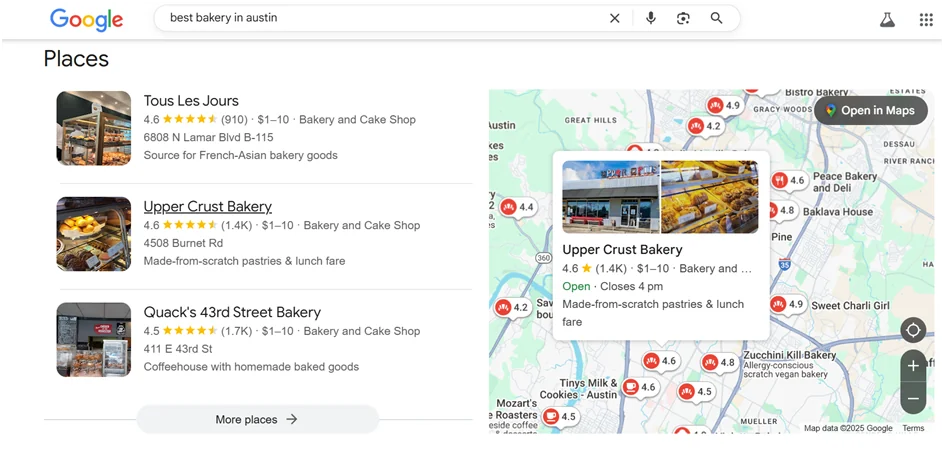
Optimizing your profile directly influences your local visibility, engagement and conversions, reputation signals, and behavioral signals.
However, the question is how to optimize your profile? You need to keep track of the following things and how to fix them if they are not performing poorly:
| Metrics | What does it means? | How to optimize the profile? |
|---|---|---|
| Profile View | How many users often view your profile? | Add relevant local keywords in your business description, upload the latest photos and posts, increase local backlinks and citations, and ensure to mention all the categories and subcategories accurately. |
| Clicks to Website | Do the users click on the website link to know more about your services? | Update the cover photo and key visuals to be more compelling, rewrite the business description to highlight clear value propositions, and add offers and clear call-to-actions in your posts. |
| Direction Requests | How many users are interested in knowing your location? | Make sure the address and service area are correct, add interior and exterior images so users know what to expect, and highlight the facilities available at your store, like parking availability and accessibility. |
| Call Clicks | Are the users taking the action to contact you? | Enable messaging and add business hours, showcase reviews that highlight your service quality, and add a stronger call-to-action in your business name or description, like 24/7 Emergency Plumbing. |
Tip 4. Analyze the Customer Reviews
Keeping a tab on customer reviews can provide different and new insights into what people actually value or dislike about your business. According to Brightlocal’s Loyal Consumer Review of 2025 report, around 75% of consumers always or regularly read reviews when searching for local businesses.
Customer reviews can give insights about:
- Keywords your customers are naturally using, as Google pays attention to these as well.
- Recurring themes in customer praise, like customer service or attention to detail, which you can mention on your website or GBP profile.
- Repeated complaints or issues, where you can improve your services.
By understanding the trends in reviews, you can feed more relevant, keyword-rich content to search engines. Also, you need to carefully handle the negative reviews because they can affect your reputation. As the best SEO company, here are two ways that should work to get rid of bad reviews:
- Ask your customers to post legitimate, detailed, positive reviews with photos.
- Respond to the negative review thoughtfully, acknowledge their concerns, and offer solutions publicly.
Consider negative reviews as an opportunity to show your human side and tell how you handle setbacks with professionalism and care. This will boost credibility and authenticity.
Tip 5. Use Google Analytics to Understand On-Site Behavior
It is a good thing that you are getting traffic on your website, but there is no surge in conversion rates. High traffic doesn’t move the needle unless those visitors actually engage, explore, and convert.
So, you need to know and map the user journey after they land on your site. Like, what pages they visit, which pages they tend to stay on more, what content they like, whether they make the purchase, or bounce off your site.
With Google Analytics, you can track:
- How long do visitors spend on your site and on what pages?
- Where are the drop-offs occurring and why?
- Which call-to-actions are boosting conversions?
By these insights, you can read the visitor behavior, and optimize the content, navigation, and design on your website to increase conversions. Like, if the CTA button consistently gets the most clicks on mobile but not on desktop, you might reposition that CTA higher on desktop pages as well.
Ready to Dominate Local Search Results?
For local businesses that are trying to boost their online presence, local SEO is an important endeavor. However, with the rise in competition, you need expertise and time to crack the code to rank higher, which is something that local businesses often struggle to manage alongside day-to-day operations.
Are you looking for local SEO services near me? Icecube Digital is the SEO expert agency that you need to accomplish your SEO goals. We have a team of experienced professionals who could solve the problems that you are facing with a solid, tried-and-tested strategy. Connect with experts, and they can suggest the best AI tools for local SEO to automate reporting.


